

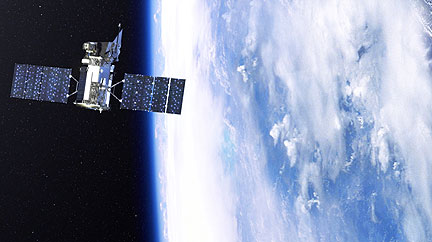
Glory, shown in this artist's concept, will study the roles of two critical elements of Earth's climate system: the sun's total solar irradiance and atmospheric airborne particles called aerosols. Both have significant direct and indirect effects on Earth's climate, and the two instruments on Glory will provide new insights into these complex processes. Credit: NASA
Originally confirmed in 2005, Glory has been developed by a team of engineers and scientists at several government, industry and academic institutions across the country. The Glory spacecraft arrived at Vandenberg on Jan. 11 after a cross-country road trip from Orbital Sciences Corporation in Dulles, Va. Glory will carry new technology designed to unravel some of the most complex elements of the Earth system. The mission carries two primary instruments, the Aerosol Polarimetry Sensor (APS) and the Total Irradiance Monitor (TIM). APS will improve measurement of aerosols, the airborne particles that can influence climate by reflecting and absorbing solar radiation and modifying clouds and precipitation.

Glory will study the roles of two critical elements of Earth's climate system: the sun's total solar irradiance and atmospheric airborne particles called aerosols. Both have significant direct and indirect effects on Earth's climate, and the two instruments on Glory will provide new insights into these complex processes. Credit: NASA
Glory will fly in a low-Earth orbit at an altitude of 438 miles, about the distance from Boston to Washington. After launch, mission operators will conduct verification tests for 30 days and then begin to collect data for at least three years. Glory's Taurus launch rocket also will carry into orbit a secondary payload: NASA's Educational Launch of Nanosatellite, or ELaNA, mission. This mission will put three small research satellites, or CubeSats, into orbit for Montana State University, the University of Colorado and a consortium of state universities called Kentucky Space.
Glory is managed by Goddard for NASA's Science Mission Directorate in Washington. Launch management is provided by NASA's Launch Services Program at the agency's Kennedy Space Center in Florida. Orbital is responsible for Glory's design, manufacture, payload integration, and testing, as well as spacecraft operations at its Mission Operations Complex in Dulles, Va. The Laboratory for Atmospheric and Space Physics at the University of Colorado at Boulder provided and will operate the TIM instrument. Raytheon Space and Airborne Systems in El Segundo, Calif., provided the APS instrument, which will be operated by Goddard's Institute for Space Studies in New York.