

...roared to life in its first hot-firing test. The engine, the IOS GPRE 7.5KNTA (General Purpose Rocket Engine: 7,500lb-thrust; Nitric Acid; Turpentine; Ablative cooling), blasted a 22-foot (6.71 meter) plume of fire across Interorbital’s Mojave Spaceport test area, scorching the sand an additional 50 feet (15.24 meters) beyond the plume end. The all-composite chamber 7.5K-pound (33,362-newton) thrust engine is the largest rocket engine in the world using high-density, storable nitric acid and turpentine. These hypergolic propellants provide almost instantaneous chemical ignition. The static firing marks a major milestone in the evolution of the company’s NEPTUNE Modular Orbital Launch Vehicle series.
Interorbital’s President and CTO Roderick Milliron commented on the success, ”The specific impulse of Interorbital’s nitric/turpentine engines is 242 seconds (sea level) and 300 seconds (vacuum). Due to the high density of these propellants, the Density Specific Impulse is 317 seconds, which allows the use of smaller and lighter propellant tanks than are required for other lower-density propellants. This fuel/oxidizer choice allows Interorbital to build a smaller orbital vehicle than would be possible with the use of LOx/ Kerosene or LOx /Alcohol. The IOS launcher can fit in a 40-ft. cargo container, smoothing transport issues and allowing highway movement of the NEPTUNE-series rockets to various launch areas.”
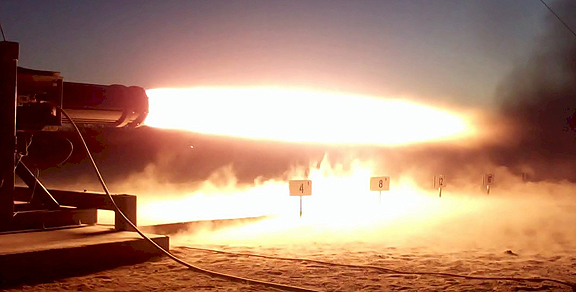
Refining the engine operation paves the way for the first flight test of the CPM (Common Propulsion Module), the stand-alone rocket that is the primary construction element of various bundled configurations that yield launch vehicles specially designed to meet specific mission requirements. IOS’ first orbital launcher is a seven-module rocket designated the NEPTUNE 7 (N7), a three-stage orbital vehicle powered by seven GPRE 7.5KNTA engines, and purposed to lift a mixed-manifest of some 24 TubeSats and CubeSats on each launch. Currently, the launch manifest boasts 45 small satellites from the US and 15 other countries, with Mission I sold out and Mission II rapidly closing. IOS will conduct the first two orbital launches from an open-ocean base off the coast of California.
Interorbital Systems, founded in 1995, recently completed a NASA Phase I SBIR contract awarded to further the development of the NEPTUNE Modular Rocket series. Video of the hot-firing is available at http://www.youtube.com/watch?v=It-Q-lhDlbg&feature=youtu.be