

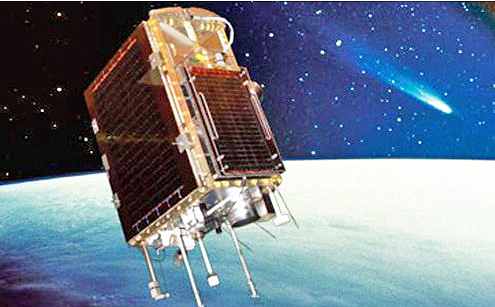
An artistic rendition of South Africa's SumbandilaSat
SumbandilaSat has been damaged by solar radiation before. Shortly after its launch in September 2009, radiation caused a power distribution failure that has rendered the Z-axis and Y-axis wheel permanently inoperable, meaning that the craft tumbles as it orbits and has lost the ability to capture imagery from the green, blue and xantrophyll spectral bands. Olivier said that the reason for SumbandilaSat not having adequate radiation hardening was that there was not enough money for it and the satellite was built from commercial off-the-shelf (COTS) equipment. SumbandilaSat was, after all, intended only as a technology demonstrator. In this regard Steenkamp said the satellite has been an enormous success and has survived far longer than anticipated. ‘Priceless’ information and experience has been gained through the satellite, experience that can only comes from actually building and launching a satellite. Such experience will be used during the construction of future satellites. Steenkamp said solar radiation is a real risk that is one of the leading causes of satellite failure. NASA has warned of future solar flares and other rough space ‘weather’, something that will create “further risks of anomalies” for SumbandilaSat.
SumbandilaSat was developed by Sunspace at an estimated cost of R100 million. Earlier this year, the Department of Science and Technology (DST) said that for every R1 invested in the SumbandilaSat program, there has been a R6 return. However, Raoul Hodges, center manager at the Satellite Application Centre (SAC), said this is not a cash value, but it's about the value for the social benefit of the country, considering the people involved, knowledge obtained and human capital investments. “You can't really put a value to a picture. It's the value taken from the picture in its use for disaster management, roads and transport. It's not a physical, cash value.”
SumbandilaSat is South Africa’s second satellite, the first being SunSat, which was built by Stellenbosch University and launched by NASA in 1999. SumbandilaSat was built by local specialist company SunSpace at a cost of R26 million, and is owned by the DST. Although its imaging capacity is not has high as other satellites, it has succeeded in its primary stated mission of proving the viability of affordable micro-satellite technology, the DST says. SumbandilaSat was launched from Kazakhstan in September 2009. It was originally scheduled for launch aboard a Russian naval submarine in 2007, but this fell through. In March, Cabinet approved the government’s move to acquire a majority stake in SunSpace. Minister of Science and Technology Naledi Pandor said the decision to buy shares in SunSpace is of strategic importance to the success of South Africa’s space program. (Source: defenceWeb)