

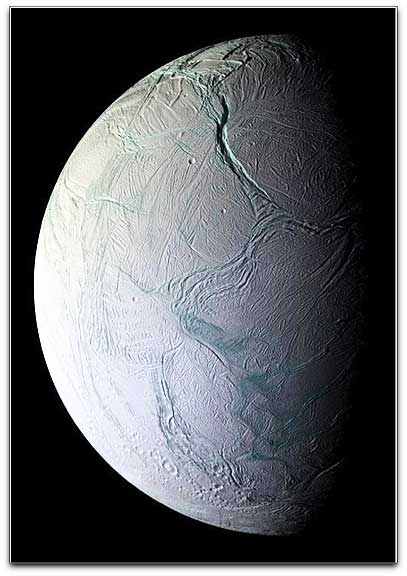
Cassini captured this mosaic on October 5th, 2008, just after coming within 25 kilometers (15.6 miles) of the surface of Enceladus.
“This episodic model helps to solve one of the most perplexing mysteries of Enceladus,” said Bob Pappalardo, Cassini project scientist at NASA’s Jet Propulsion Laboratory in Pasadena, California, of the research done by his colleagues. “Why is the south polar surface so young? How could this amount of heat be pumped out at the moon’s south pole? This idea assembles the pieces of the puzzle.” About four years ago, Cassini’s composite infrared spectrometer instrument detected a heat flow in the south polar region of at least 6 gigawatts, the equivalent of at least a dozen electric power plants. This is at least three times as much heat as an average region of Earth of similar area would produce, despite Enceladus' small size. The region was also later found by Cassini’s ion and neutral mass spectrometer instrument to be swiftly expelling argon, which comes from rocks decaying radioactively and has a well-known rate of decay. Calculations told scientists it would be impossible for Enceladus to have continually produced heat and gas at this rate. Tidal movement — the pull and push from Saturn as Enceladus moves around the planet — cannot explain the release of so much energy.