

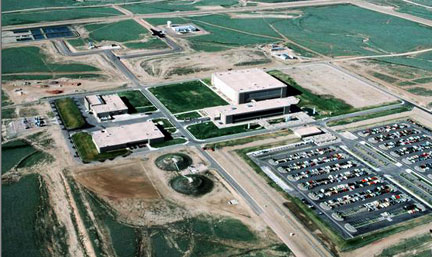
[SatNews] Throughout the 30 years of this operations center, much has been accomplished, and the origin is even more intriguing...
After the formation of AFSPC, the new command immediately began to work toward the eventual assumption of the satellite telemetry, tracking, and commanding (TT&C) mission. Construction of the Consolidated Space Operations Center (CSOC) at Falcon AFS Colorado began in May of 1983 with its completion in September 1985.
The facility was designed to provide operations centers for all DoD satellite and manned space missions. CSOC's operations facilities gradually took over command and control responsibilities for most Air Force satellites including the NAVSTAR Global Positioning System (GPS), the Defense Satellite Communication System (DSCS), DMSP, the Defense Support Program (DSP), and Milstar.
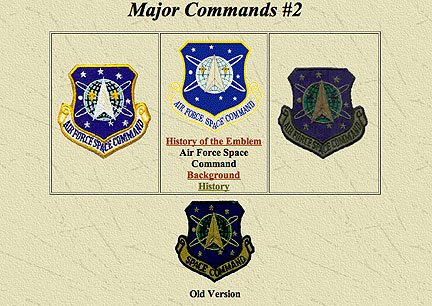
THE HERITAGE OF AIR FORCE SPACE COMMAND
A rich history is shared at this site. A synopsis of some of the highlights that may pique your interest are as follows:
The end of World War Two brought with it new challenges and new technology. The German V-1 cruise missile and V-2 ballistic missile demonstrated the possibilities of long-range rockets for warfare and, perhaps, space travel.
The frantic scramble for Nazi technology and scientists in the closing days of the war created an air of international competition that foreshadowed the coming Cold War. The western Allies, particularly the United States and United Kingdom, raced to acquire as much German military technology as possible before the Soviets could take possession of certain areas of Germany. In the end, the cream of Germany's rocket scientists, including Wernher von Braun, fled west to escape the Soviets. Under the auspices of Operation Paperclip, the U.S. quickly "recruited" the Germans to help the fledgling U.S. rocket program...more
Early Visions of Space Operations
In January 1946, the RAND Corporation (then still part of Douglas Aircraft) published Preliminary Design of an Experimental World-Circling Spaceship, which discussed the feasibility of launching satellites into orbit for purposes of scientific study, global communication, and observation. This study, along with extensive research using captured German rockets (Projects Bumper and Hermes), laid the early groundwork on which later programs, like Convair's Project MX-774 and von Braun's Project Orbiter, would build.
Throughout the decade after the Soviets detonated their first hydrogen bomb in 1953, U.S. military experts became increasingly concerned with the possibility of a surprise Soviet nuclear attack on the U.S...more
The Gaither Commission
In 1957, the Eisenhower Administration, created the Gaither Commission to review the state of U.S. civil defense in the event of a Soviet nuclear attack. On its own, the commission broadened its mandate to include the capability of the U.S. military, particularly Strategic Air Command's (SAC) forces, to survive a nuclear attack and still carry out their retaliatory mission. The findings were not encouraging...more
The First Space Tracking Stations
In 1957, the NRL constructed a worldwide network of simple radio tracking stations called "Minitrack" to track the new satellite. This system used satellite transmitted radio signals to track Vanguard as it passed over each station. At the same time, the Smithsonian was continuing work on its global network of Baker Nunn cameras intending to use them to track Vanguard. These large telescopic cameras, based on the Schmidt telescope, were designed specifically to provide space object tracking information on satellites...more
The First Satellite
Sputnik immediately demonstrated the woeful inadequacy of Minitrack. Since Sputnik did not transmit on a known radio frequency, Minitrack could not track it without considerable effort, and once the satellite stopped transmitting, the system could not track it at all. The lack of published orbital parameters severely handicapped the civilian observers of Moonwatch. The Baker Nunn camera network was not yet completed, and the Moonwatch teams became the mainstay of the Sputnik tracking effort...more
"Aerospace"
In 1959, the Air Force redefined its overall mission to include the space arena and coined the word aerospace to describe its new mission. At the same time, Air Defense Command (ADC) the primary air defense provider for the CONUS assumed the ballistic missile warning mission. (In January 1968 the name was changed to Aerospace Defense Command (ADC) to reflect the change of mission.) In September 1959, the Chief of Naval Operations, Admiral Arleigh Burke suggested to the JCS the creation of a unified space command to control all DoD space assets and missions. The Army agreed, but the Air Force was unenthusiastic. Interservice rivalry would continue to keep military space systems under divided command for another twenty-six years....more
NORAD Created
Back in September 1957, the U.S. and Canada had created the North American Air Defense Command (NORAD), the first binational, joint-service military command on the North American continent. This new defense partnership, headquartered at Ent AFB Colorado, was responsible for air defense of the combined airspace of the U.S. and Canada. Air Defense Command was the Air Force component of Continental Air Command (CONAD), the U.S. component of NORAD...more
Anti-Ballistic Missile Programs
Since the late 1950s, the U.S. military had sought to create an anti-ballistic missile (ABM) system to guard against the Soviet missile attack which seemingly loomed on the horizon. Although many systems were designed, only Safeguard ABM reached operational status....more
Strategic Air Command's Era In 1979, during a major restructuring effort, administrative control of all space surveillance and missile warning assets were transferred from Air Defense Command to Strategic Air Command. NORAD retained operational control of the missile warning and space surveillance sites. Within a short time, this arrangement, which still left most other space systems scattered among many different agencies, was found to be unsatisfactory....more
A New Command is Born
During activation ceremonies for Space Command on 1 September 1982, General James V. Hartinger declared his pride at having been selected as its first commander. Labeling its establishment "a crucial milestone in the evolution of military space operations," he predicted the new command would "provide the operational pull to go with the technology push which has been the dominant factor in the space world since its inception....more"
Consolidation of Space Missions
This vital "heads up" assisted Army Patriot missile...Much more