

The Tiangong-1 will orbit the Earth for about one month to await Shenzhou-8 unmanned spacecraft. Once the two vehicles successfully rendezvous, they will conduct the first space docking at a height of 340 kilometers above Earth surface. The 8.5-ton Tiangong-1, with a length of 10.4 meters and maximum diameter of 3.35 meters, provides a room of 15 cubic meters for two to three astronauts to live and work.
Zhang Shancong, deputy chief designer of the Tiangong-1, told Xinhua that the module carries special cameras which will take hyperspectral images of China's vast farmlands to detect heavy metal pollution and pesticide residue as well as plant disease. Moreover, scientists on the ground will also conduct experiments on photonic crystal, a new material expected to revolutionize information technology, in the low-gravity environment inside the Tiangong-1 as these experiments would be extremely difficult to conduct on Earth's surface.
"China is clearly becoming a global power and its investments in areas like technology and exploration reflect this," said Peter Singer, a senior fellow at the Washington-based Brookings Institution. "It is a natural result of the growth in political and economic power and is to be expected."
Zhou Jianping, chief designer of China's manned space program, told Xinhua that China will turn its future space station into an international platform for space research and application. A space station could provide a low-gravity environment for research on geography, astronomy and bio-technology, which will bring unimaginably greater achievements than those conducted on Earth's surface, he said. "The Chinese nation has pursued peace since ancient times," Zhou said. "China's ultimate intention with the space program is to explore space resources and make use of them for mankind's well-being."
China has expressed its strong willingness to cooperate with other countries in exploring space. So far, China's Long March rocket series has successfully sent more than 20 satellites into space for the United States, Australia, Pakistan and other countries and regions. One Chinese scientist and five international peers have also participated in Russia's Mars-500 Program, a ground-based experiment simulating a manned expedition to Mars.
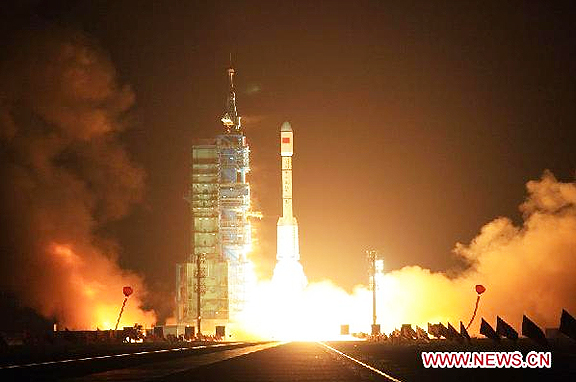
A Long March-2FT1 carrier rocket loaded with Tiangong-1 unmanned space lab module blasts off from the launch pad at the Jiuquan Satellite Launch Center in northwest China's Gansu Province, Sept. 29, 2011. (Xinhua/Wang Jianmin)
< President Hu Jintao on Thursday night applauded the successful launch of China's first space lab module Tiangong-1, and shook hands with the staff of the Beijing Aerospace Flight Control Center. Other members of the Standing Committee of the Political Bureau of the Communist Party of China (CPC) Central Committee, including Wu Bangguo, Jia Qinglin, Li Changchun, Xi Jinping, Li Keqiang and Zhou Yongkang, were also present at the control center. Premier Wen Jiabao and He Guoqiang, also members of the Standing Committee of the Political Bureau of the CPC Central Committee, shook hands with the staff at the Jiuquan Satellite Launch Center to congratulate on the success. (Source: Xinhua.)