

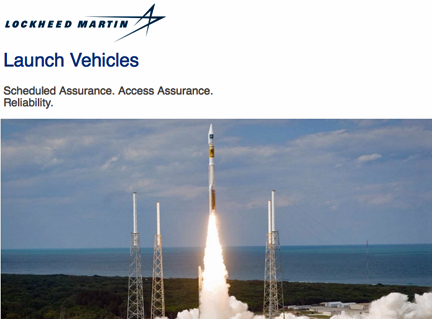
 [SatNews] Lockheed Martin Commercial Launch Services (LMCLS), a wholly-owned subsidiary of the Lockheed Martin Corporation [NYSE: LMT], has been selected by the Secretaria de Comunicaciones y Transportes, a government agency of Mexico, to provide commercial launch services using the Atlas V launch vehicle for Mexico’s Morelos-3 communications satellite (also known as MEXSAT-2). The launch is scheduled to occur as early as 2015 from Cape Canaveral Air Force Station, Florida.
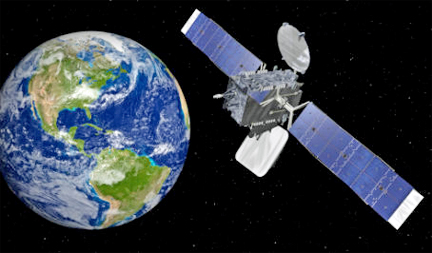
Artistic rendition of the Morelos-3 (MEXSAT-3) satellite,
to be built by Boeing.
"We are extremely pleased to be selected for this vital mission that will provide the government of Mexico with world class Atlas launch services for the Morelos-3 satellite, supporting the nation’s growing satellite communications needs,” said Robert R. Cleave, President, Lockheed Martin Commercial Launch Services.
Lockheed Martin is the exclusive provider of commercial Atlas rockets. With dedicated launch sites, unparalleled orbital insertion accuracy, and 110 consecutive successful launches to date, Atlas is unmatched for performance, reliability and schedule assurance in meeting global satellite customer needs.
The MEXSAT program provides communications to rural zones as a complement to other networks and will also provide secure communications for Mexico’s national security needs. Satellite services include education and health programs, voice, data, video, and internet services.
Lockheed Martin Commercial Launch Services, a business unit of Lockheed Martin Corporation, markets the Atlas V to commercial satellite customers worldwide and also offers Athena launch services for small satellites and multi-payload RideShare missions. LMCLS is responsible for contracts, marketing, sales and mission management for commercial and international government Atlas missions and all Athena missions. Under subcontract to LMCLS, United Launch Alliance provides Atlas launch vehicles and launch support services.
Secretaria de Comunicaciones y Transportes is a Mexican government agency with a primary objective to promote secure, efficient, and competent transport and communications systems through the design of strategies that foster economic growth and development.
Telecomunicaciones de México is a decentralized government agency with 150 years’ experience in providing communications services in Mexico, and operated the Morelos and Solidaridad satellite systems in the 1980s and 1990s.
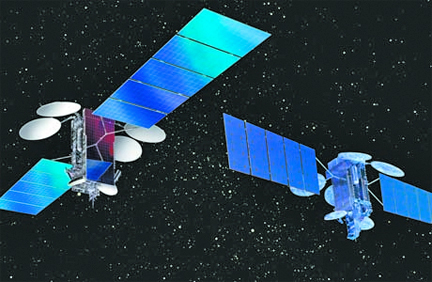
Artistic rendition of Lockheed Martin's A2100 bus, courtesy of Lockheed Martin.
The new A2100 technical update addresses design architecture and manufacturing processes, offering satellite operators catalog-to-order solutions that leverage common parts, subsystems and components to meet specific customer and mission needs.
"We literally are transforming our business, engineering and production processes," said Linda Reiners, president of Lockheed Martin Commercial Ventures, a major line of business within Lockheed Martin Space Systems Company. "Across-the-board benefits enable A2100 production at lower cost, risk and reduced cycle time, which yields shorter time-to-orbit and quicker time-to-revenue generation for commercial customers."
The updated A2100 design features the following advantages:
-
Power solutions for a wide range of low-to-high power requirements
Propulsion flexibility that includes all-electric, all-liquid, or hybrid systems optimized to customer business plans; the all-electric propulsion will provide up to half the time-to-orbit capability than other electric systems;
Improved link performance and increased traffic capacity
Extended mission life
High-performance thermal design
Dual launch capability, featuring lowest cost-to-orbit and highest payload accommodation
"Product architecture, engineering, design and manufacturing process innovation, combined with our extensive A2100 heritage, ensures a low-risk approach that provides maximum capability to our domestic, international and government customers," continued Reiners. "Standard interfaces across all of our satellite programs streamline spacecraft integration and minimize non-recurring engineering costs."
There are currently 45 A2100 spacecraft in orbit, including 39 commercial satellites and six satellites performing U.S. government missions. The fleet is equipped with more than 1,500 transponders transmitting data, video and audio for satellite operators worldwide. The satellite platform meets a wide variety of telecommunications needs, including Ka-band broadband and broadcast services, fixed satellite services in C-band, Ku-band and X-band, high-power direct broadcast services using Ku-band mobile and satellite services using EHF, UHF, L-band, and S-band payloads.