

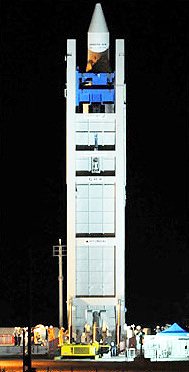
Engineers watch the Korea Space Launch Vehicle (KSLV-1) as it is raised on a launch pad at the Naro Space Center in Goheung, South Jeolla Province, Monday. South Korea’s second space rocket, a joint project with Russia, is commissioned to put a research satellite into orbit tomorrow. The first delivery attempt in August failed. Yonhap
The problem appears serious enough to possibly delay the launching of the rocket, with a control committee consisting of South Korean and Russian engineers expect to meet early today to determine whether to continue the liftoff as scheduled. The 33.5-meter, 140-ton rocket was scheduled to be fired into space at approximately 5:00 p.m. Wednesday carrying a satellite aimed at observing the atmosphere and ocean. The previous KSLV-1 launch in August last year ended in disappointment when it reached the desired height but failed to put the payload satellite into orbit. The next launch will come against the backdrop of heightened tensions on the Korean Peninsula following North Korea's attack on the warship, Cheonan, which led to the deaths of 46 South Korean sailors in March.
The vehicle's journey from the assembly building to the pad took about an hour and 20 minutes. After arriving at the pad at around 9:40 a.m., the rocket was inspected by South Korean and Russian engineers before being raised vertically by an erector in late in the evening. The rocket positioning was supposed to be completed by around 5:00 p.m., but was delayed for hours after engineers detected unstable electric signals after the rocket was attached to the pad's cable-mast. Engineers at Naro later claimed they corrected the problem, but have yet to pinpoint the exact cause of the anomalies or confirm whether their corrections were sufficient enough. The rocket was raised on the pad with the cable-mast detached.
The two-stage KSLV-1 has a thrust of 170 tons and is capable of launching a satellite weighing 100 kilograms into low orbit. Russia's Khrunichev State Research and Production Space Center, which is providing the core technologies for the South Korean rocket project, designed and manufactured the rocket's 25.8-meter first stage, or the lower part that contains the rocket engine and liquid fuel propulsion system. KARI developed the upper part of the vehicle that will hold and eject the payload satellite, Science and Technology Satellite No. 2 (STSAT-2). It remains to be seen if weather will play as a factor Wednesday, as lightning within the 20 kilometer radius of the launch area and the rocket's flight trajectory would be enough for KARI to postpone the launch. Strong winds, particularly high winds that blow harder than 21 meters per second, may also affect the rocket's stability during the ascent. KARI officials, however, say Wednesday's launch will likely progress as scheduled unless there is torrential rain. (Source: The Korea Times)