

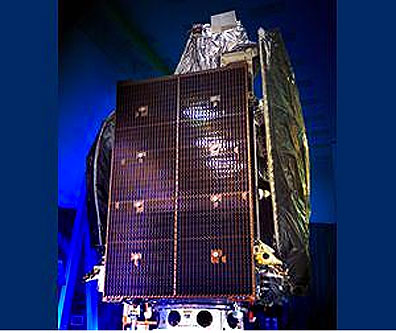
 [SatNews] All spacecraft systems have been checked out after the successful on-orbit deployment and Maven's construction for NASA progresses well...
The BSAT-3c/JCSAT-110R broadcasting satellite, designed and built by Lockheed Martin [NYSE: LMT] for the Broadcasting Satellite System Corporation (B-SAT) and SKY Perfect JSAT Corporation, is now ready for service following successful on-orbit deployment and checkout of all spacecraft systems. The satellite is located at orbital location 110 degrees East and will provide service for Japanese companies B-SAT and SKY Perfect JSAT, which jointly procured the satellite. BSAT-3c/JCSAT-110R incorporates two independent Ku-band payloads with 12 direct broadcast channels and 12 fixed direct communication channels providing uplink and downlink coverage throughout Japan. BSAT-3c/JCSAT-110R is required to meet a 15-year service life and was designed entirely with flight-proven components integrated into the highly reliable A2100 platform.
The BSAT-3c payload joins BSAT-3a and BSAT-3b to provide more than 120 million television sets in Japan with BS digital broadcasting programs. The JCSAT-110R payload will serve as a back-up for the 110 degrees East orbital position, continuing to provide highly reliable SKY PerfecTV! e2 service for its customers. This is the third consecutive satellite Lockheed Martin has delivered to B-SAT and the fifth consecutive satellite delivered to SKY Perfect JSAT. Lockheed Martin successfully delivered BSAT-3a and BSAT-3b in August of 2007 and December of 2010, respectively. Lockheed Martin is currently building JCSAT-13 and previously built JCSAT-9 through JCSAT-12 and JCSAT-110 for SKY Perfect JSAT.
The Lockheed Martin A2100 satellite series is designed to meet a wide variety of communications needs including Ka-band broadband and broadcast services, fixed satellite services in C- and Ku-band, high-power direct broadcast services using the Ku- and Ka-band frequency and mobile satellite services using UHF, L-, and S-band. The A2100's modular design features simplified construction, increased on-orbit reliability and reduced weight and cost. The A2100 design accommodates a large range of communication payloads and serves as the platform for critical government communications programs, including the Advanced Extremely High Frequency and Mobile User Objective System satellites. The A2100 can also be configured for missions other than communications. It has been adapted for Lockheed Martin’s Geostationary Operational Environmental Satellite Series-R Earth observing mission and serves as the platform for Lockheed Martin’s GPS III satellites.
The Company has also completed building of the primary structure of NASA’s MAVEN spacecraft at its Space Systems Company facility near Denver.
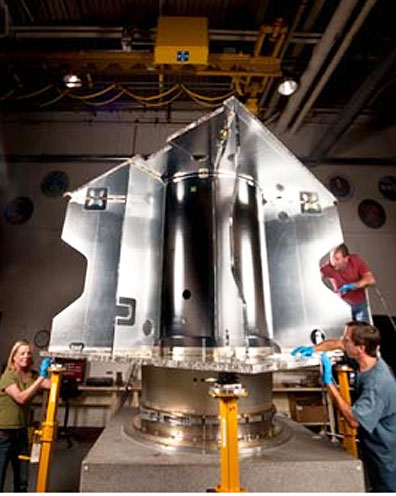
Technicians from Lockheed Martin are inspecting the MAVEN primary structure following its recent completion at the company’s Composites Lab near Denver.
In mid October, the structure will be moved to Lockheed Martin’s Structures Test Lab and undergo static load testing, which simulates and tests the many dynamic loads the spacecraft will experience during launch. Despite the primary structure’s light weight, it’s designed to support the entire spacecraft mass during the launch, which applies an equivalent axial force at the launch vehicle interface of approximately 61,000 pounds when including accelerations up to 6 Gs. After completion of the static tests, the structure will be moved into a clean room to start propulsion subsystem integration. The Assembly, Test and Launch Operations (ATLO) phase begins July 2012.