
Home >> News: January 18th, 2011 >> Story
Satnews Daily
January 18th, 2011

IAI... Supply An Even Dozen To Russia (UAV)


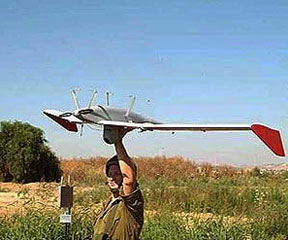
The IAI Bird-Eye 400 UAV
[SatNews] Israeli Aerospace Industries has delivered a dozen unmanned aerial vehicles to Russia under a $400 million contract that will eventually allow Moscow to manufacture advanced drones that will significantly enhance its military capabilities.


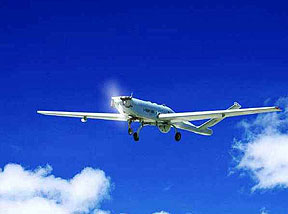
The IAI I-View Mk 150 UAV
The delivery of the short-range Bird-Eye 400 and I-View Mk 150 aircraft, plus the longer-range Searcher II, in recent weeks is part of an Israeli effort to encourage the Russians not to provide Iran and Syria with advanced weapons systems that could threaten the Jewish state, The Jerusalem Post reported. The UAVs delivered by state-owned IAI, flagship of Israel's high-tech defense industry, stemmed from a ground-breaking April 2009 contract worth $53 million. That marked Russia's first purchase of a foreign weapons system. That, in turn, led to the $400 million deal between IAI and Russia's Oboronprom OPK Group in October 2010 under which the Russians will independently manufacture the Heron 1, one of Israel's most advanced UAVs capable of strategic missions. As part of the deal, IAI trained some 50 Russian pilots at its main facility near Ben Gurion International Airport near Tel Aviv.

The Heron TP is 79 feet long and has a wingspan of 86 feet and can stay aloft for 20 hours at high altitudes, making it capable of reaching Iran from Israel. Moscow's decision last June to scrap an $800 million contract to provide Iran with powerful S-300PMU air-defense missile systems clearly has helped Israel overcome its reservations about providing technology to Russia. Tehran wanted the systems to protect its nuclear installations, which the Israelis have threatened to attack. The S-300s would have been a formidable obstacle for Israeli warplanes. Israel wants Moscow to ditch plans to sell Syria the advanced supersonic P-800 Yakhont cruise missile that could pose a series threat to Israel's navy, particularly if they are passed on to Hezbollah in Lebanon. From the Russian point of view, the deals with Israel underline how Moscow is accelerating efforts to obtain major military platforms from the West, a fundamental revision of Russian military procurement strategy. Securing licenses from foreign defense manufacturers, such as IAI, to produce the equipment in Russia is significant as it will bolster the Kremlin's plans to revive its moribund defense industry over the next decade.