


China Xichang Satellite Center; The launch of Tianlian I-01 satellite (a Data Relay & Tracking Satellite); The newly developed Long March 3C Carrier Rocket.
JINA Banner, Inner Mongolia Autonomous Region — As China launched its first space lab module into outer space, 78-year-old Grandma Chagan was still dreaming of her homeland which was given up for the construction of the country's spaceflight base 53 years ago.
"I remember that it happened in 1958 when helicopters landed near my yurt and workers began exploring the base site. Then we received an order to remove. We took apart our yurts, packed our households, picked up our kids and herded the sheep and camels along — leaving our homes forever," said Chagan in Mongolian language, when recalling her childhood homeland in Ejina Banner in Alxa League in Inner Mongolia.
More than half a century ago the Chinese government selected the area around the Banyan Bogd Mountain near the desert of Ejina, some 2,000 km away from Beijing, as the nation's first satellite launch site. More than 1,400 herdsmen of Tuerhute tribe of Mongolian had to move away from their homes and find new places to live. Since then, they wandered on the desert for eight years.
Their original homeland later became the well-known Jiuquan Satellite Launch Center, also known as Dongfeng Space City, where China tested the launching of its first surface-to-surface missile, first nuclear missile, first satellite, first long-range rocket and first manned spacecraft...
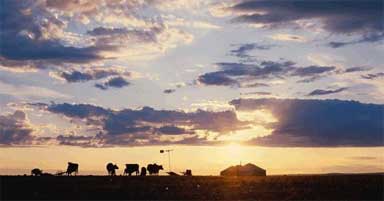
Chagan said she used to live in Baori Ulan village with 200 other families and 70,000 sheep on 4 million hectares of pasture.
"The road of farewell to homeland stretched longer and longer as people got on their way," she said.
"The base constructors sent trucks to help us, transporting the old people and children, as well as the luggage. The rest followed the sheep and camels to the strange desert," said Chagan, who was 25 at that time. She said the desert was ruthless and it was difficult for them to find water.
"But our homeland was the most beautiful oasis," said 69-year-old Nanselma. She said that she was so reluctant to leave that she made several clay sheep and camels and put them under the jarrah bushes to keep watch of her abandoned home.
"They stayed instead of me," Nanselma said....
The rest of this article can be found at. By Xinhua Writers Ji Shaoting, Chai Hailiang, Wu Jihai and Han Song.