

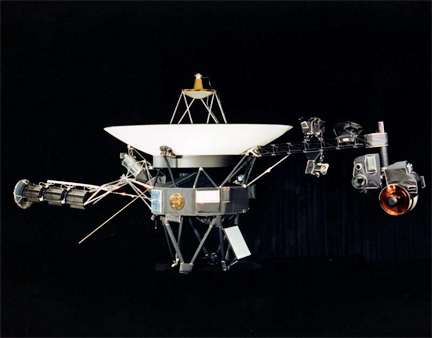
Artistic rendition of the Voyager I satellite,
courtesy of NASA/JPL.
Scientists have seen two of the three signs of interstellar arrival they expected to see: Charged particles disappearing as they zoom out along the solar magnetic field and cosmic rays from far outside zooming in. Scientists have not yet seen the third sign, an abrupt change in the direction of the magnetic field, which would indicate the presence of the interstellar magnetic field.
"This strange, last region before interstellar space is coming into focus, thanks to Voyager 1, humankind's most distant scout," said Ed Stone, Voyager project scientist at the California Institute of Technology in Pasadena. "If you looked at the cosmic ray and energetic particle data in isolation, you might think Voyager had reached interstellar space, but the team feels Voyager 1 has not yet gotten there because we are still within the domain of the sun's magnetic field."
Scientists do not know exactly how far Voyager 1 has to go to reach interstellar space. They estimate it could take several more months, or even years, to get there. The heliosphere extends at least 8 billion miles beyond all the planets in our solar system. It is dominated by the sun's magnetic field and an ionized wind expanding outward from the sun. Outside the heliosphere, interstellar space is filled with matter from other stars and the magnetic field present in the nearby region of the Milky Way.
Voyager 1 and its twin spacecraft, Voyager 2, were launched in 1977. They toured Jupiter, Saturn, Uranus and Neptune before embarking on their interstellar mission in 1990. They now aim to leave the heliosphere. Measuring the size of the heliosphere is part of the Voyagers' mission.
The Science papers focus on observations made from May to September 2012 by Voyager 1's cosmic ray, low-energy charged particle and magnetometer instruments, with some additional charged particle data obtained through April of this year.
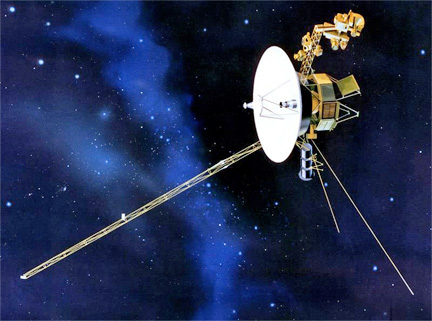
Another artistic illustration of the Voyager spacecraft,
courtesy of NASA + JPL.
"We saw a dramatic and rapid disappearance of the solar-originating particles. They decreased in intensity by more than 1,000 times, as if there was a huge vacuum pump at the entrance ramp onto the magnetic highway," said Stamatios Krimigis, the low-energy charged particle instrument's principal investigator at the Johns Hopkins University Applied Physics Laboratory in Laurel, Maryland. "We have never witnessed such a decrease before, except when Voyager 1 exited the giant magnetosphere of Jupiter, some 34 years ago."
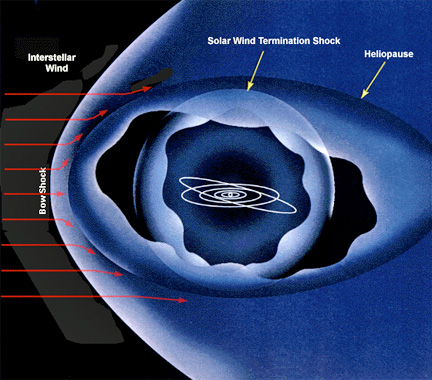
The heliosphere is the immense magnetic bubble containing our solar system, solar wind, and the entire solar magnetic field. It extends well beyond the orbit of Pluto. While the density of particles in the heliosphere is very low (it's a much better vacuum than is created in a laboratory), it is full of particles of interest to heliospheric scientists. Check out the image below for a diagram of the heliosphere.
Image courtesy of NASA + JPL.
In the span of about 24 hours, the magnetic field originating from the sun also began piling up, like cars backed up on a freeway exit ramp. But scientists were able to quantify the magnetic field barely changed direction—by no more than 2 degrees.
"A day made such a difference in this region with the magnetic field suddenly doubling and becoming extraordinarily smooth," said Leonard Burlaga, the lead author of one of the papers, and based at NASA's Goddard Space Flight Center in Greenbelt, Maryland. "But since there was no significant change in the magnetic field direction, we're still observing the field lines originating at the sun."
NASA's Jet Propulsion Laboratory, in Pasadena, Calif., built and operates the Voyager spacecraft. California Institute of Technology in Pasadena manages JPL for NASA. The Voyager missions are a part of NASA's Heliophysics System Observatory, sponsored by the Heliophysics Division of the Science Mission Directorate at NASA Headquarters in Washington.