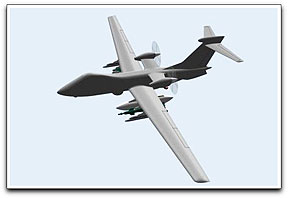
BAE Systems has successfully flown the largest fully autonomous unmanned aircraft ever to be built in the U.K. The nexgen autonomous system,
MANTIS, completed its maiden flight in Woomera, South Australia.
During subsequent flights,
MANTIS successfully completed a series of trials demonstrating the capability of the system and the potential of large unmanned systems to support future
U.K. Ministry of Defence (
MOD) operational needs. The MANTIS program is jointly funded by U.K. MOD and U.K. Industry.
Defence Equipment & Support Director Combat Air, Air Vice-Marshal
Simon Bollom said, "These trials at the end of this technology demonstration program have successfully demonstrated a number of key factors that have helped build confidence in the feasibility of a UK-derived medium altitude long endurance unmanned aerial system".
During phase one of the program,
BAE Systems has been working alongside the U.K. MOD and key industrial parties including:
- Rolls- Royce - Integrated Propulsion System & Engine Clearance
- QinetiQ - Flight Termination System and Communication System
- GE Aviation - Electrical Power System and Primary Flight Control Actuation
- Meggitt - Electrical Braking System
- Selex Galileo - future Mission Systems and Sensor requirements
MANTIS has a 20-m wingspan and is BAE Systems’ first all-electric aircraft. The system is intended to be easily deployable and can be broken down to fit into a military transport aircraft. MANTIS is designed to be a real workhorse with “plug and play” elements in the mission system and the ability to carry a wide range of sensors. MANTIS can execute its mission with a much reduced need for human intervention by understanding and reacting to its environment. Such autonomy increases operational effectiveness allowing more focus on the mission without the usual concerns over vehicle control. It also reduces manpower requirements and the risk of accidents due to human error and the communications/data link requirements between the vehicle and the ground. MANTIS could carry out intelligence gathering at long distances and can carry significant payloads in terms of sensors and, potentially, weaponry.
Topical Tags :
Regional Tags :

