

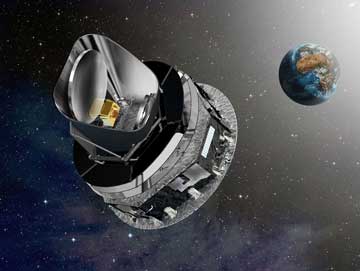
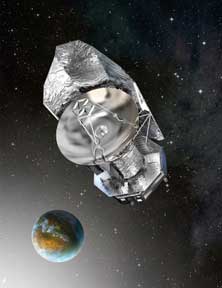
Since they’ve reached their operational orbit and completed their commissioning, Herschel and Planck have been providing a flow of data of tremendous quality to the science community. Scientists are now eager to reveal their findings based on what is only the first season of an unprecedented vision of our Universe.
While Planck has already once mapped the complete universe and is starting its second mapping, with Herschel many science observations have been conducted since then and these new results will be presented to the medias on May 6 2010 in ESTEC.
For Thales Alenia Space and its industrial partners, the successes logged by Herschel and Planck is a demonstration of the high level of engineering and technological skills achieved by their teams. It also illustrates the success of an intricate cooperation between Thales Alenia Space, its institutional partners, the European Space Agency and the observatory’s final users, namely the science community, to deliver them the best tools to perform the most demanding and the most rewarding missions.
Thales Alenia Space’s expertise and know-how were built on the development of many prestigious science missions for the European Space Agencies, national agencies including NASA, such as the Hipparcos astrometry mission, the Infrared Space Observatory (ISO), the BeppoSAX X-ray observatory, the Cassini/Huygens mission to Saturn and Titan, the International Gamma Ray Astrophysics Laboratory (Integral) and the Corot planet-finder as well as a major contribution to many others including Mars and Venus Express orbiters or the Rosetta comet chaser.
Tomorrow, this expertise will be provided to meet future science endeavors like the ExoMars missions for the exploration of the Red Planet and other missions to be decided to expand the reach of our scientific knowledge.