

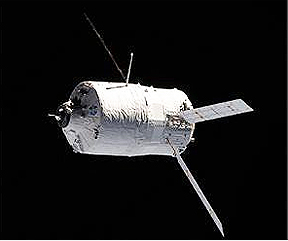
The ATV 'Edoardo Amaldi', designed and built by Astrium, is the third unmanned European freight spacecraft for the International Space Station (ISS).
...the ATV (Automated Transfer Vehicle) "Edoardo Amalfi." The company supplied the structure for the ATV’s propulsion module, the special racks for accommodating the payloads in the cargo bay, and the mechanism that will separate Edoardo Amalfi from the rocket at an altitude of 260 kilometres after launch. RUAG Space also delivered thermal insulation for the spacecraft and a highly reliable computer, the Monitoring and Safing Unit, MSU, that keeps an eye on safety during the automatic docking manoeuvres and has the mandate to abort docking and park the ATV on a safe distance to ISS if any parameter gets out of bounds.
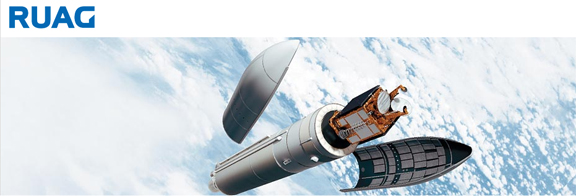
Weighing more than 20 metric tons, the ATV will be carried into space by a special version of the European launcher, Ariane 5. After separation from the rocket, the transfer vehicle will continue to fly towards the International Space Station using its own propulsion system. On March 29th, ‘Edoardo Amalfi’ is scheduled to dock fully automatically with Russia’s Zvezda module on the ISS. Once the docking maneuver is completed, the space transporter will be an integral part of the ISS and the astronauts will be able to enter the ATV’s cargo hold in normal clothing without needing space suits. The supply ship will remain docked to the space station until August 17th. During this time, the ISS crew will gradually unload the supplies and experiments. However, the space freighter has another important function: Due to the residual atmosphere in the orbital path of the ISS at an altitude of 400 kilometres, the space station is gradually decelerated and loses height. While the ATV is docked on, it will re-boost the ISS at regular intervals with the thrust from its own engines. On completion of the ATV mission, the astronauts will deposit their waste in the cargo hold of the ATV, which will finally be separated from the ISS and fly back to Earth. It will re-enter the Earth’s atmosphere on a steep flight path and burn up.