

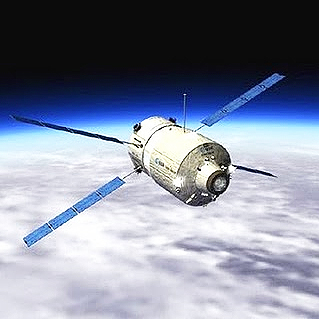
 [SatNews] Now that system testing has been completed on number three...
Edoardo Amaldi, the third European cargo spacecraft for the International Space Station (ISS), is on its way to the European spaceport in Kourou, French Guiana. The Automated Transfer Vehicle (ATV) has undergone extensive system testing at Astrium’s Bremen site over the last few months and has now been given the go-ahead for the final stage prior to the cargo spacecraft’s flight to the ISS.
“Edoardo Amaldi” is slated for launch in the spring of 2012. On behalf of the European Space Agency (ESA), Astrium is responsible for both development and production of the ATV. The production of ATV units two to five – as well as mission preparation and operations support – is covered by the “Exploitation” contract, which governs the operation and provisioning of the European components of the ISS. Astrium is responsible for carrying out these activities on ESA’s behalf. “Edoardo Amaldi” is the second production unit, following on from the highly successful first flight model Jules Verne and the first production unit Johannes Kepler. Astrium has orders for a total of four ATV production units from ESA – a testimony to the high reliability Astrium has shown as ESA’s prime contractor for the development of ATV and also of Columbus.
“The extension of the ISS mission until 2020 presents Astrium with further opportunities in regard to both the supply and the operation of the ISS,” explained Dr. Michael Menking, Astrium’s Senior Vice President of Orbital Systems and Exploration, speaking as the ATV set off from Bremen on Thursday. He also confirmed that production of the ATV units is currently running according to schedule: “Edoardo Amaldi” is on its way to Kourou, and ATV 4 Albert Einstein has reached the integration stage in Bremen. Menking added that delivery of the first batch of structures for ATV 5 is imminent, which will enable integration work to begin soon.
ATV must comply with the safety requirements for human spaceflight. Thus ATV’s digital and electronic architecture features double and triple redundancies. A fault-tolerant computer – consisting of three computer modules – ensures the reliable and smooth execution of the ATV mission. “With the retirement of the US Space Shuttle, ATV is the largest vehicle supplying the ISS. Considering its technological challenges, like automatic rendezvous and docking, ATV is the most sophisticated space vehicle ever built in Europe,” said Menking.