...that will operate its Crew Space Transportation (CST) spacecraft. The company is one of NASA's partners developing commercial crew transportation capabilities to ferry U.S. astronauts to and from low Earth orbit and the International Space Station. With the Preliminary Design Review (PDR) of its software on May 18th, the company now has completed more than 40 milestones under partnerships supporting NASA's Commercial Crew Program (CCP).
Boeing's CST-100 is designed to be a reusable, capsule-shaped spacecraft, capable of transporting up to seven people or a combination of people and cargo. It is compatible with a variety of expendable launch vehicles. Boeing has selected United Launch Alliance's Atlas V rocket for initial CST-100 test flights. Software is essential to all operational aspects of the spacecraft, including launch, orbital maneuvering, docking with and separating from the space station, re-entry and landing. The testing is part of a NASA-funded Space Act Agreement under the second round of the agency's commercial crew development (CCDev2) activities, which could eventually lead toward human spaceflight certification of the CST-100.
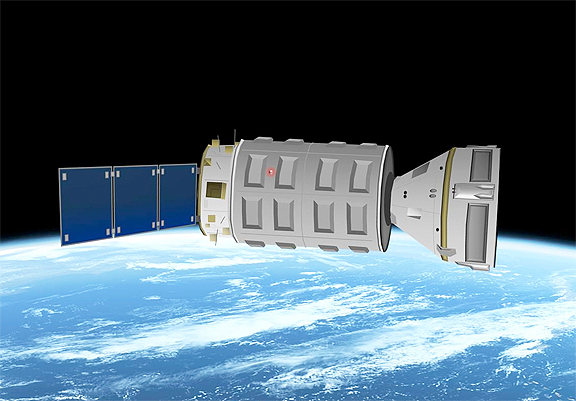
Rendering of a Boeing CST-100 capsule mated with an Orbital Sciences Cygnus spacecraft. (Credit: Ben McGee)
The Boeing team is on schedule to complete its remaining CCDev2 milestones in the next few months, including an orbital maneuvering/attitude control engine hot fire test that will provide additional data on significant elements of the spacecraft design. All of NASA's industry partners, including Boeing, continue to meet their established milestones in developing commercial crew transportation capabilities.