

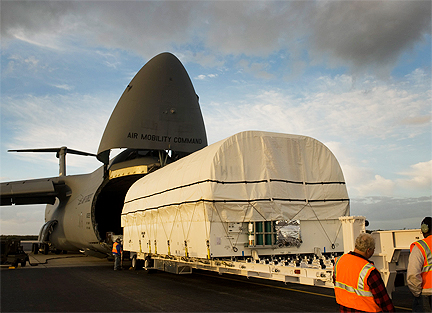
The first Space Based Infrared Systems geosynchronous (GEO-1) satellite was off-loaded from a C-5 Galaxy aircraft at Cape Canaveral Air Force Station, Fla., March 3. The encapsulated satellite was transported to the Defense Satellite Communications System Processing Facility where final check out and tests will be performed prior to launch. SBIRS GEO-1 is scheduled for launch in early May aboard an Atlas V Launch vehicle.
The milestone, known as the SBIRS System Test 5001.4 Regression Test demonstrated the ability to transmit data between the spacecraft and flight control facilities, and perform the critical operational functions of the SBIRS GEO-1 integrated ground and space system. This pre-launch test was held at various locations in Colorado and California. "Successful completion of this critical test is a reflection of the dedication and hard work of the Team," stated Lt. Col. Douglas Sersun, acting director, SBIRS Systems Engineering and Integration.
The completion of this test marked a significant milestone in the SBIRS program as it ensured the readiness of ground and flight software products to support an early May launch. With factory testing complete, the team shipped GEO-1 to Cape Canaveral Air Force Station, Fla., March 3, 2011. The satellite is currently going through a series of launch preparation tests to verify satellite integrity after shipment from the Sunnyvale, Calif., factory. These tests will verify communication compatibility between the satellite and the on-orbit operations center.
SBIRS replaces the legacy Defense Support Program constellation. The state-of-the-art SBIRS sensors will provide significantly enhanced capabilities to support four mission areas: Missile Warning, Missile Defense, Battlespace Awareness and Technical Intelligence. The SBIRS team is led by the Infrared Space Systems Directorate at the U.S. Air Force Space and Missile Systems Center located in Los Angeles, Calif. The Lockheed Martin Space Systems Company, located in Sunnyvale, is the SBIRS prime contractor.