

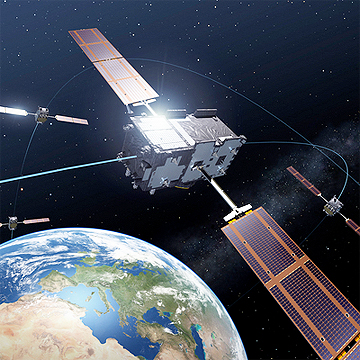
Four Galileo In-Orbit Validation satellites in medium-Earth orbit, the minimum number needed to perform a navigation fix.
Credits: ESA – P. Carril
...test navigation signals back to Earth. The two Galileo satellites launched last October have reached their final orbital position and are in the midst of testing. The third Galileo Flight Model, known as FM3, transmitted its first test navigation signal in the E1 band on December 1st, the band being used for Galileo’s freely available Open Service interoperable with GPS. Then, on the morning of December 4th, the satellite broadcast signals across all three Galileo bands—E1, E5 and E6.
Galileo is designed to provide highly accurate timing and navigation services to users around the world. So the testing is being carried out in addition to the standard satellite commissioning to confirm that the critical navigation payloads have not been degraded by the violence of launch.
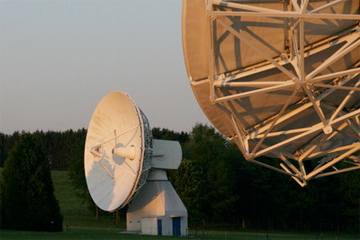
ESA's Redu centre in Belgium used for Galileo In-Orbit Testing. On 1 December 2012 this is where the first test navigation signal from the third Galileo satellite, FM3, was received from.
Credits: ESA
Operating at an altitude of 23 222 km, the Galileo satellites take about 14 hours to orbit our planet, typically coming into view of Redu for between three to nine hours each day.
The fourth Galileo flight model, FM4, was launched together with FM3 on 12 October. The two satellites shared the same Soyuz launcher from French Guiana. Both have now been manoeuvred into their operational orbits: at the same altitude but in a different orbital plane to the first two Galileos, launched in 2011, in order to maximise the global coverage. Now that FM3’s payload has been activated, FM4 is set to begin transmitting test navigation signals later this month. The first two satellites have already passed their in-orbit testing.