

....successful launch of the first Vega by the European Space Agency (ESA), placing two scientific satellites and seven picosatellites into orbit. Thanks to this historic success, Arianespace now has the largest range of commercial launch services. Vega has been designed to launch payloads of up to 1,500kg at an altitude of 700km. This means that Europe now has a new vehicle to launch all its scientific and institutional missions. After the success of this maiden launch, Arianespace will be in charge of the commercialization and exploitation of Vega.
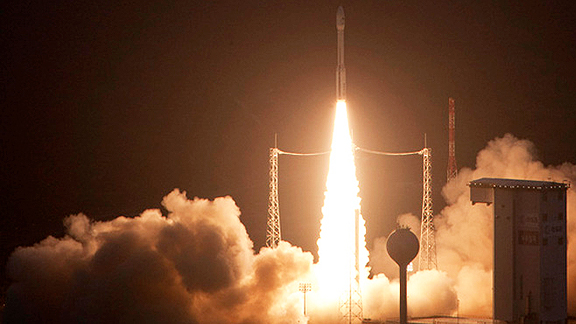
The European Space Agency's first Vega rocket lifts off from Guiana Space Center in Kourou, French Guiana in a flawless launch debut.
Photo courtesy of ESA /Stephane Corvaja.
With Ariane 5, Soyuz, and now Vega, all of which are operated from the Guiana Space Center, Arianespace is the only launch service and solutions company that can place any payload into any orbit: telecommunications satellites, scientific or Earth observation satellites, constellations and missions to the International Space Station.
Following this historic success, Jean-Yves Le Gall, Chairman and CEO of Arianespace, said, "Bravo Europe! Congratulations to the European Space Agency, to the Italian Space Agency, to the Centre National d'Etudes Spatiales and to all our industrials partners. This success comes after 9 years of cooperative development. Well done Europe!"
Even before this first launch Arianespace and ESA had already signed the first commercial launch service and solutions contract, for the European Union launch of Sentinel-2 and Sentinel-3 spacecraft on Vega.
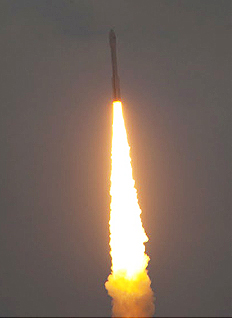
The Vega liftoff...photo courtesy of Arianespace.
The Vega is powered by three solid propellant stages and a liquid-propellant fourth stage. It was developed by the European Space Agency, Italy’s ASI space agency, and the French CNES space agency. Production is handled in an industry team led by industrial prime contractor, ELV SpA. Vega’s flexibility enables varied payloads to be carried – from a single passenger to mixes of satellites, microsatellites and cubesats.