

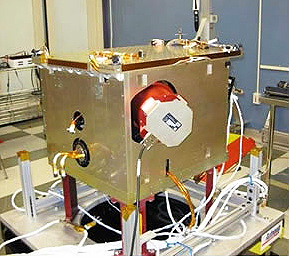
 STPSat-2 is the first spacecraft in Ball’s STP Standard Interface Vehicle product line that is compatible with multiple launch vehicles and supports a variety of experimental and risk reduction payloads at different low-Earth orbits. The standard payload interface can support up to four independent payloads, each having its own separate power and data interface. STPSat-2 is one of seven satellites and 16 experiments to make up the STP-S26 mission. The two experiments mounted on the payload standard interface module of the first STP-SIV satellite include the Space Phenomenology Experiment (SPEX) which includes two payloads to evaluate sensor compatibility for the space environment; and the Ocean Data Telemetry MicroSatLink (ODTML) which will relay data from ocean and terrestrial sensors to users.
Ball Aerospace will complete work on an identical STP-SIV - STPSat-3 spacecraft by the end of 2010 that will host four experimental military payloads. Integration of payloads on the STPSat-3 spacecraft will begin in February 2011. In 2006, Ball Aerospace was awarded a contract for up to six STP-SIV spacecraft. STPSat-2 is the first spacecraft for the Department of Defense Space Test Program Standard Interface Vehicle program managed by the Space Development and Test Wing at Kirtland Air Force Base, Albuquerque, N.M. The STP-SIV architecture developed for STPSat-2 supports the Operationally Responsive Space strategy to ensure U.S. space superiority. This is the first launch of a Ball Aerospace spacecraft from the state-of-the-industry spacecraft on Kodiak Island, working successfully with the Alaska Aerospace Corporation.