

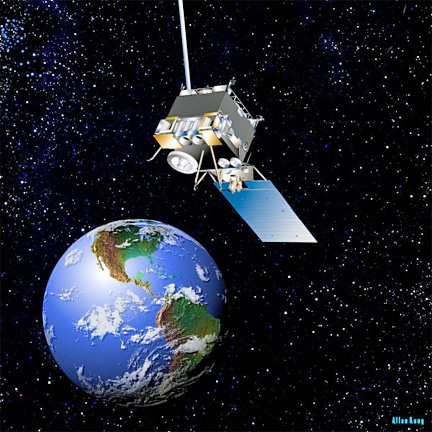
Artistic rendition of the GOES 13 satellite.
“It doesn’t appear that there was any damage or any problem with any of the instruments on board,” said Capt. Debora Barr, acting deputy director of NOAA's Office of Satellite and Product Operations in Suitland, Maryland, in an interview. She said engineers were examining all possibilities of what could have caused the satellite to have an unplanned movement in space, including a collision with small debris, or space junk, or an instrument malfunction. “We can’t find anything wrong with it,” Barr said of the satellite.
The GOES-13 satellite has been responsible for keeping a constant vigil over the eastern U.S. and North Atlantic, taking many of the satellite images that are shown on TV weather broadcasts and, more importantly, feeding weather data in computer models used for forecasting. To ensure that weather forecasts don’t suffer while GOES-13 is out of service, NOAA maneuvered a backup satellite, known as GOES-14, into place to cover most of the area covered by GOES-13.
To troubleshoot the satellite, engineers restarted it, much like one would do with a frozen computer, bringing it out of orbital storage mode. To ensure that GOES-13’s sounder instrument—which is critical for weather forecasting since it gives meteorologists a vertical profile of conditions in the atmosphere—functions properly, they are performing what is known as an “outgassing procedure” to try to minimize interference with the transfer of data from the spacecraft to receiving stations at Wallops Island, Virginia.
Shortly before the satellite suffered from the incident on May 22nd, the sounder was sending information in a slightly degraded fashion, Barr said. She said the outgassing procedure should take about four days, and that the satellite could be back in service as soon as June 5. That would be just in time for the 2013 Atlantic Hurricane Season's first storm threat, which some computer models suggest could form in the Gulf of Mexico late next week. The sounder on that satellite malfunctioned in September 2012, leading to the satellite’s temporary shutdown then as well.
The satellite outage, while not a significant threat to forecast accuracy at this time, is providing scientists with a preview of what’s to come during the next several years as lengthy gaps in satellite coverage become more likely. NOAA’s policy has been to keep two GOES satellites in orbit at all times, along with one backup. However, the first satellite in the next-generation as GOES spacecraft won’t be launched until the fall of 2015. Across-the-board budget cuts to federal programs, known as the sequester, may cause the launch date of the first GOES-R satellite to slip, which could result in a period without any redundancy in deployed satellites, as the current satellites begin exceed their design lifetime.
If the GOES-R series of satellites are delayed, that would put the GOES program on a similar troubled path as the polar satellite program. A year-long gap in polar satellite coverage is likely to come in 2017, potentially degrading the accuracy of medium-range forecasts. NOAA has said that without polar satellite data, simulations have indicated that the five-day forecasts for Hurricane Sandy would have shown the storm going out to sea, rather than veering sharply toward the New Jersey shore.
The lengthy delays in NOAA’s satellite programs have led to efforts to open the weather satellite sector to additional privatization. A draft House bill would allow the government to purchase weather data from privately operated weather satellites, which would be a significant change from the current system in which the government procures the satellites from private companies, such as the aerospace giant Boeing, and then operates the spacecraft itself, freely distributing the data to the public.