

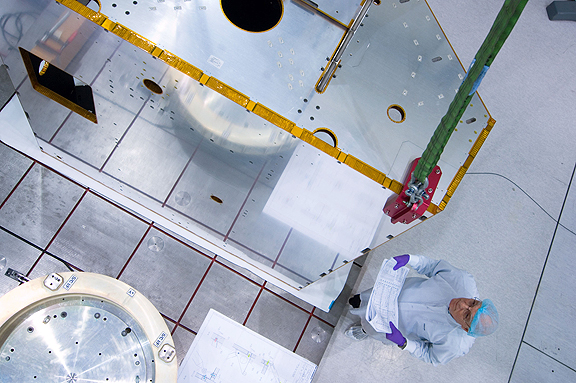
The structure of the European ice research satellite CryoSat-2. The satellite will measure the thickness of the polar ice caps.
CryoSat will chart the world's ice masses for at least three years, observing any changes in mountain glaciers and the polar ice caps. Built in Sweden, the antennas are not the only contribution of RUAG Space to the ESA's new environmental satellite: the satellite's base structure was made in Switzerland and its thermal insulation comes from Austria. What is more, RUAG supplied the ground equipment for transportation and testing of the satellite.
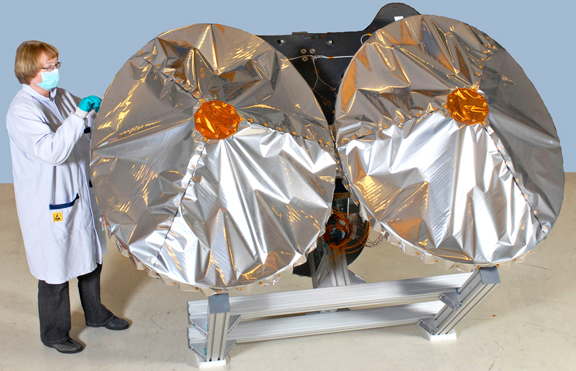
Stereoscopic radar antenna, manufactured by RUAG Space in Sweden, for the ice research satellite CryoSat. The ESA satellite will investigate changes of the global ice masses.
The polar ice masses have a huge influence on the world's climate. Should they melt, the resulting melt water could have a substantial impact on sea currents and thus on the global climate. As yet it is not clear whether, and to what extent, the ice masses will recede. While the ice at the North Pole is evidently shrinking, the ice cover at the South Pole currently appears to be on the increase. The data gathered by satellites thus far has failed to deliver clear-cut information; although it allows us to determine the spread of the ice sheets, it tells us nothing about their thickness. It is this gap in our knowledge that CryoSat-2 now will close. The satellite is equipped with an innovative radar instrument that can be used to determine exactly how thick the ice sheets are. And this instrument's "eyes", two specialized radio antennas, are the work of RUAG Space in Sweden. Both the antennas and the base plate supporting them were designed by RUAG Space and built in cooperation with Saab using composite technology. The antennas are aluminum plated and enclosed in a special thermal membrane to keep the disturbances caused by the extreme temperature fluctuations in space to a minimum. Known as multi-layer insulation (MLI), this membrane was manufactured by RUAG Space in Austria and protects the antennas as well as the interior of the satellite.
CryoSat-2 is a replica of the first CryoSat satellite, which crashed into the Arctic Ocean shortly after launch in October 2005 owing to a programming error in the Russian launch vehicle Rockot.