

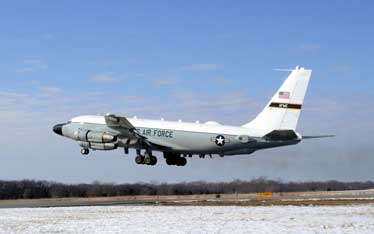
Boeing's RC-135 Rivet Joint reconnaissance aircraft carries the U.S. Air Force's FAB-T hardware in a demonstration of in-flight communications to ground platforms.( U.S. Air Force photo)
The U.S. Air Force announced today that it installed, integrated and successfully flight-tested a second-generation Family of Advanced Beyond Line-of-Sight Terminal (FAB-T) onboard a test version of an RC-135 Rivet Joint reconnaissance aircraft.
During the flight test, a FAB-T terminal onboard an RC-135 test aircraft connected with a Milstar satellite. The U.S. Air Force test team then communicated from the air with test locations on the ground via the Milstar satellite. As part of the in-flight testing, voice, data and text were shared between the aircraft and ground users who were part of the demonstration network.
"This first series of integration and flight tests on the RC-135 aircraft demonstrates that the second-generation terminal is able to pass low-data-rate communications between airborne and ground platforms in flight," stated Maj. Jeff Miller, FAB-T program office test team lead.
"This test validated that size, weight and power requirements have been satisfied, while the actual flight test performance reinforced that the program continues to burn down risk in the development of this command and control system."
"This successful installation of FAB-T on a test version of an intelligence-gathering aircraft platform like the RC-135 brings the Department of Defense one step closer to a revolutionary new high data rate, secure communication capability to deliver much higher quantities of actionable intelligence products into the hands of the warfighter," said Dave Madden, MILSATCOM systems director, Air Force Space and Missile Systems Center.
"This success resulted from exceptional cooperation between the L-3 Com contractors performing the integration, the government program office, and Boeing. This significantly reduces risk for future platform integration of production terminals by demonstrating integration of this complex system onto an RC-135."
"This is a significant accomplishment as the RC-135 was the first FAB-T user platform to be integrated with an actual airborne terminal," said John Lunardi, Boeing FAB-T vice president and program director. "Integrating the system with the platform user and then successfully exercising terminal communications over-the-air in-flight demonstrates the continuing maturity of the FAB-T system."
Boeing is working toward low-rate initial production and completing qualification of the airborne hardware. The FAB-T products include software-defined radios capable of protected communications, antennas and associated user interface hardware and software that will provide the government with a survivable and powerful system.
The FAB-T program office is based out of the United States Air Force Electronic Systems Center at Hanscom Air Force Base, Massachusetts and managed by the MILSATCOM Systems Directorate at Los Angeles Air Force Base, California. The MILSATCOM Systems Directorate plans for, acquires and sustains space-based global communications in support of the President, Secretary of Defense and combat forces. The MILSATCOM enterprise consists of satellites, terminals and control stations and provides communications for over 16,000 air, land and sea platforms.