

Musk said the flight-proven Falcon 9 launch vehicle and Dragon spacecraft represent the safest and fastest path to American crew transportation capability. With their historic successful flight on December 8th, 2010, many Falcon 9 and Dragon components that are needed to transport humans to low-Earth orbit have already been demonstrated in flight. Both vehicles were designed from the outset to fly people. The announcement comes at a time when the United States has a critical need for American commercial human spaceflight. After the Space Shuttle retires in a few months, NASA will be totally dependent on the Russian Soyuz to ferry astronauts to and from the International Space Station (ISS) at a cost of more than $753 million a year -- about $63 million per seat. Musk said Dragon – designed to carry seven astronauts at a time to the space station at a cost of $20 million a seat – offers a far better deal for the U.S. taxpayer. While considerable flight testing remains, the critical-path technology Dragon needs for carrying humans to orbit is the launch escape system.
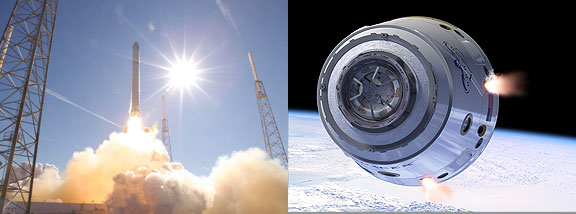
Left: On December 8th, 2010 SpaceX launched a Dragon spacecraft on a Falcon 9 rocket from the Cape Canaveral Air Force Station. This mission made SpaceX the first commercial company to recover a spacecraft returning from orbit, and the only CCDev winner to have already successfully flown its vehicle. Credit: Chris Thompson, SpaceX
Right: Artists image of the Dragon spacecraft in orbit. The new launch abort system provides crew with emergency escape capability throughout the entire flight and returns with the spacecraft, allowing for easy reuse and radical reductions in the cost of space transport. Credit: SpaceX