

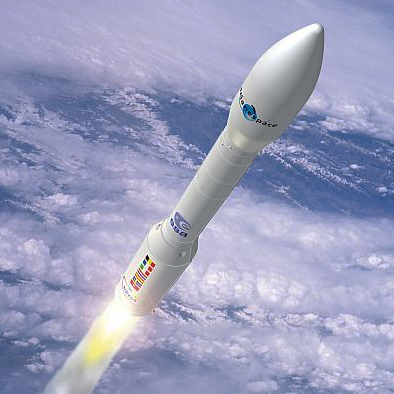
This is the lightweight launchers voyage from Europe to South America by sea. The vehicle will be positioned in South America for its inaugural flight next January at the Spaceport. Stocked aboard the MN Colibri roll-on/roll-off ship, the Vega is scheduled to depart Rotterdam in the Netherlands on October 6th for a transatlantic crossing to French Guiana for unloading and transfer to the Spaceport. This will clear the way for a Flight Readiness Review on October 13-14, enabling the mission’s three-month launch campaign to start in November.
Vega’s liftoff next January – with a multi-spacecraft payload composed of the LARES satellite and nine small cubesats from European universities – will serve as the vehicle’s qualification flight, opening a series of missions to demonstrate the launch system’s flexibility. When it joins Arianespace’s family of launchers, Vega will be capable of lofting payload masses ranging from 300 kg. to 2,500 kg. depending on the type of orbit and altitude required by customers. The baseline mission is for a payload lift performance of 1,500 kg. to a 700 km. polar orbit.
For the upcoming ocean voyage, the MN Colibri is carrying Vega’s Zefiro-23 and Zefiro-9 solid rocket motors for its second and third stages, along with the launcher’s bi-propellant liquid AVUM upper stage, all of which were delivered from Avio’s facility in Colleferro, Italy, where they were produced. These components were brought to the MN Colibri at the Port of Livorno in Italy, after which the vessel sailed to Rotterdam where the cargo was to be increased with the Vega’s Swiss-built payload fairing, the Dutch-produced interstage structure that links the launcher’s first two stages, as well as the LARES laser relativity satellite from Italy’s ASI space agency.
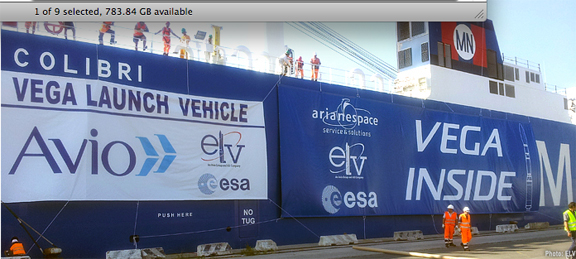
The MN Colibri is shown at Italy’s Port of Livorno, where it was loaded with the Vega’s second and third stage solid rocket motors, along with the launcher’s bi-propellant liquid upper stage.
The MN Colibri is one of two sea-going vessels used by Arianespace in transporting launcher components between their European production locations to South America, and the upcoming ocean crossing repeats a process regularly employed in the shipment of heavy-lift Ariane 5s, as well as the medium-lift Soyuz. After the Vega elements arrive in French Guiana, they will be integrated with the launcher’s P80 solid propellant first stage, which currently is undergoing final preparations in the Spaceport’s Booster Integration Building.