[SatNews] The architecture to provide the U.S.A.F. with a platform that increases efficiencies, all the while reducing management costs and development time, will be seen at NSS...
Integral Systems, Inc., (Nasdaq:ISYS) has announced that
it will be demo'ing its comprehensive ground segment Enterprise
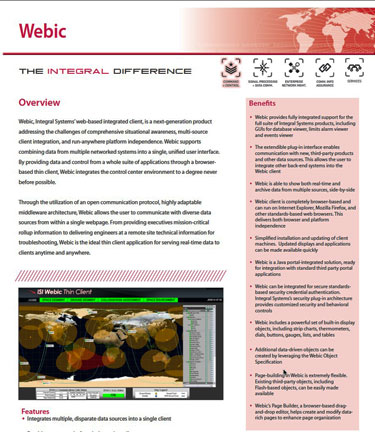
Architecture powered by the Company's Webic™ integrated thin client at the 27th National Space Symposium (NSS) at booth #408. Integral Systems' Enterprise Architecture with Webic was designed to align with United States Air Force (USAF) requirements for a standards-based platform that reduces development and ongoing management costs, increases operational efficiencies, enables access to real-time, actionable data and facilitates interoperability across multiple systems.
As a flexible alternative to current USAF stove-piped architectures,
Integral Systems' Enterprise Architecture with Webic provides
significant benefits to the satellite operations (SatOps) and Launch
Range operational and acquisition communities. Operationally, the
architecture facilitates comprehensive Situational Awareness (SA)
providing real-time insight into all ground, launch and space
components, while the service-based architecture promotes
interoperability with systems across the larger enterprise. The Company's
approach provides a common look and feel through universal Command and
Control (C2) services and user displays, increasing operational
efficiencies and reducing operations and maintenance costs. The
Enterprise Architecture also reduces acquisition develop-ment costs by
eliminating multiple independent C2 systems, enabling operationally
responsive integration of new missions and facilitating modernization
of outdated components and systems.
At the 27th National Space Symposium, Integral Systems will be
featuring multi-faceted SatOps and Launch RangeOps demonstrations
showcasing the power of its Enterprise Architecture. The demonstrations
will show how a satellite operator or launch range operator can benefit
from having real-time, mission critical information on a single easy to
understand display. Access to relevant, time critical data allows the
operator to make more informed decisions, thereby increasing the
likelihood of mission success. The SatOps demonstration will show how satellite operators can use the Enterprise Architecture to obtain complete SA of their space and ground segment assets. By integrating mission-relevant multi-source data from Integral Systems' best-in-class C2, Radio Frequency (RF) interference monitoring and detection, network management and signal processing products, as well as third-party products and data sources, operators will have real-time status of Blue and Grey Force space and ground support assets, cyber, space environment, site weather, Air Force Satellite Control Network (AFSCN) and other relevant information.
The Launch RangeOps demonstration will include three different
scenarios: pre-countdown, countdown to launch and launch/insertion.
Each scenario will show how the Common Operational Picture (COP)
provides critical mission information, including range status
(instrumentation, communications, tracking and mission support),
booster and payload, area clearance (airspace, ocean surveillance, land
clearance and constraint violation), weather (radar imaging at launch
site and base stations) and flight safety (flight control systems). Integral Systems' Enterprise Architecture features a blended approach
that supports both Event Driven Architectures (EDA) and Service
Oriented Architectures (SOA) to offer the greatest flexibility for
different projects. Webic supports multi-source display, providing
updated information to a number of different users. New data sources
can be easily added to the interface by accessing a data source
registry. Integral Systems' Enterprise Architecture with Webic enables
flexibility and interoperability, supporting changes in both
capabilities and middleware/SOA implementations while minimizing system
impact.