

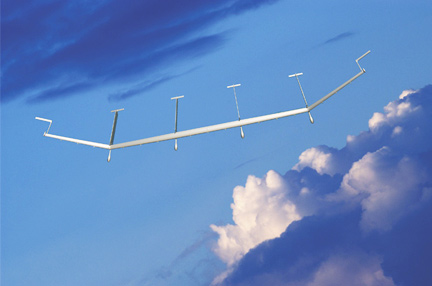
 [SatNews] A small team of engineers from Newcastle University have secured a big contract.
These engineers will help British defense firm QinetiQ build a monster, record-breaking solar-powered plane for Boeing. The unmanned plane is called SolarEagle and its sun-sapping panels will keep it in the air at an altitude of more than 18km for five years at a time. While it's up there, the aircraft will feed back data to troops on the ground for communications, intelligence and surveillance purposes. The SolarEagle will also be the largest aerial vehicle in the world with a mammoth wingspan of 120 metres. That's bigger than Airbus' massive, wide-body A380 passenger jet (about 75 metres), and even wider than a regulation football pitch (105 metres).
However, having a gigantic plane travelling at heights where the temperature can dip to -60 degrees Celsius holds some big design hurdles for the engineers. This is especially true in the creation of an engine that can drive the propellers to lift the plane off the ground, while still being efficient and light-weight. That's where the Newcastle University team comes in, as Professor Barrie Mecrow and the university's Centre for Advanced Electrical Drives have secured the contract to develop SolarEagle's engine. "The work is particularly challenging because the plane will be flying at a height of more than 60,000 feet where temperatures can be below minus 60 degrees and conventional systems stop working," said Mecrow. He said it will be "a big challenge for us."
The team last collaborated with QinetiQ on Zephyr, another solar-powered UAV. It's a pint-size plane with a 22.5 metre wingspan that can travel at similar altitudes to SolarEagle, and it grabbed the endurance record for unmanned aerial flight after a 336 hour (two week) journey. Newcastle University hopes to have the first two prototypes of the plane's motors ready to test in the next six months. SolarEagle's first test flight is tentatively pencilled in for 2014. (Source: Mark Brown, Wired.co.uk)