

The Defense Department is expanding partnerships with spacefaring companies and nations to maintain the strategic advantage it gains in space, the deputy assistant secretary of defense for space policy said today. Speaking with reporters from the Defense Writers Group, Ambassador Gregory L. Schulte said NASA's final space shuttle flight this week represents "a time of transition" for the civil and military space programs. "Space," Schulte said, "is increasingly congested, contested and competitive."
The Omaha, Neb.-based U.S. Strategic Command, whose mission now includes warning companies and countries when space debris threatens their satellites, is tracking more than 22,000 objects in space, he said. A range of countries are developing counter-space capabilities, including satellite-damaging jammers and lasers, he added, and 11 countries now operate 22 launch sites.
"The United States is not the only player in space," Schulte said, "and space is certainly not our private domain. Space is ubiquitous in the defense establishment and in the conduct of military operations, he added, "and we're acting to maintain our strategic advantage in space." Space is critical to ground navigation, smart bomb precision, and to relay unmanned aerial vehicle feeds to troops, Schulte said. Space also is necessary for early warnings of missile launches and for keeping the president connected to U.S. nuclear forces. Space is a force multiplier, Schulte added. "Without space capabilities, we'd need a lot more bombs to put on a particular target and there would be a lot more casualties and collateral damage. Without space assets, we'd need a lot more troops on the ground doing counterinsurgency operations."
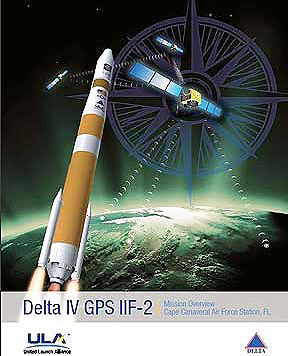 To maintain the advantage, Schulte said, "we just launched [the] second in a series of GPS satellites that's going to give us more jam resistance and better civil capacity." The Defense Department recently launched a new space-based infrared satellite, the first in geosynchronous orbit, that will offer much better tactical intelligence for missile launches, Schulte said. DOD also is putting into orbit the first of four advanced extremely high frequency, or EHF, communications satellites, he said, and a new space-based surveillance satellite that will boost the ability to track objects in space.
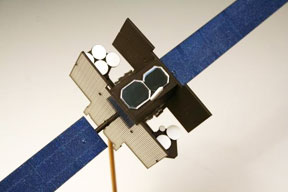
Artistic rendition of the Wideband Global SATCOM
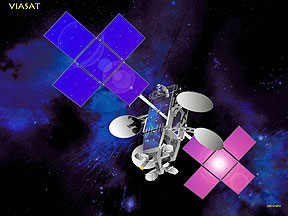
"Another illustration of the way forward," Schulte said, "is a program that our Defense Information Systems Agency, DISA, has proposed to Congress." The program is called ASSIST, for Assured SATCOM Services in a Single Theater, which is the U.S. Central Command's area of operations. "DISA is proposing to commercially procure satellite services to support the warfighter, rather than just leasing the services year to year," the ambassador said. "In doing so," he added, "we can save significantly on annual leasing costs and we can also get access to satellites that have three times the capacity of the closest U.S. government-owned satellite."

Artistic rendition of the SES-2 satellite, hosting the CHIRP payload
The Defense Department is working with NASA, the White House and others to develop a new space transportation policy to update the 2004 presidential policy, he said. "The new policy will reflect the end of the shuttle program but also that there are potential new entrants into space launch, and that our ranges are not only used for national security missions, but also increasingly for commercial missions," Schulte said.
SpaceX is another space transportation company that works routinely with the Air Force range at Patrick Air Force Base at Cape Canaveral, Fla., he added. "Industry has read this strategy and has come to us with all sorts of ideas about innovative approaches to taking advantage of commercial capabilities and thinking differently about space," Schulte said. "And we welcome that." (Source: American Forces Press Service, Cheryl Pellerin)