

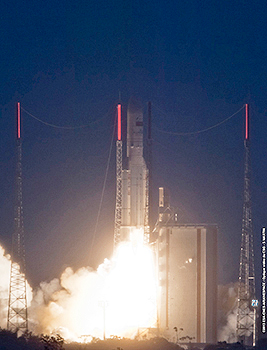
The Ariane 5 begins its ascent with this evening’s record-setting payload to geostationary transfer orbit.
Photo courtesy of Arianespace.
..Arianespace. The company witnessed the successful launch of two telecommunications satellites: Amazonas-3 for Spanish operator Hispasat, and Azerspace/Africasat-1a for Azercosmos OJSC, Ministry of Communications and Information Technologies of Republic of Azerbaijan. The 68th launch of Ariane 5 set a new record for weight injected into geostationary transfer orbit: the launcher on this mission carried a total payload of 10,317kg, including 9,503kg. for the two satellites, Amazonas-3 and Azerspace/Africasat-1a. This was the first Ariane 5 launch of 2013.
“This performance demonstrates once again the pertinence of our improvement policy, which enables us to augment the capacity of our launcher while maintaining its reliability,” said Arianespace Chairman & CEO Jean-Yves LeGall in comments at the Spaceport.
The back-to-back missions also underscored the flexibility of Arianespace’s launcher family composed of the heavy-lift Ariane 5 utilized today at French Guiana, the medium-lift Soyuz employed in yesterday’s flight from Kazakhstan (on a mission performed by its Starsem affiliate), and the new light-lift Vega – which currently is being readied for its no. 2 Spaceport launch.
Le Gall noted that the smooth countdown to Ariane 5’s liftoff at 6:36 p.m. local time in French Guiana highlights the competence and maturity of Arianespace’s launch teams, which are trained to oversee operations with the company’s launcher family trio. Le Gall said coming up next at French Guiana is a launch targeted for April with Vega (designated Fight VV02 in Arianespace’s launcher family numbering system), using this light-lift vehicle to orbit the European Space Agency’s Proba-V satellite for monitoring of global vegetation growth, along with the VNREDSat-1A Earth observation satellite for Vietnam.
Amazonas-3was launched by the HISPASAT Group, and it is the seventh Spanish satellite launched by Arianespace and Ariane 5 is the only commercial satellite launcher now on the market capable of simultaneously launching two payloads. The company first launched the Hispasat 1A and 1B satellites in 1992 and 1993, respectively, followed in 2005 and 2006 by the XTAR-Eur and Spainsat satellites for Hispasat and its subsidiary Hisdesat. Amazonas-2 was launched in 2009, followed by Hispasat 1E in 2010.
Approximately 28 minutes after the rocket ́s takeoff, the separation of the Amazonas 3 satellite from the launch vehicle occurred, and ignition and deployment of its solar panels were initiated. Afterwards, the maneuvers were started to position the new satellite in its geostationary orbit where the test phase to verify its correct operation will be carried out. Once the tests are completed, in a few weeks, the satellite will be placed in its definitive geostationary orbit at the Brazilian orbital position of 61 degrees West.
For the CEO of HISPASAT, Carlos Espinós, “this new satellite, the company ́s tenth, consolidates the Group as the main communications bridge between the European and American continents. It brings a new advance with the incorporation of Ka-band to provide interactive services and multimedia applications via satellite to a large number of users, and thus extend access to the majority of the population. The HISPASAT Group is the primary satellite operator to offer this possibility in Latin America. Our goal is to continue offering our clients innovative and high quality services adapted to their communications needs.”
With a 15 year lifespan, the new satellite will provide coverage to the American continent, Europe and North Africa from the Brazilian orbital position of 61 degrees West. Operated by HISPAMAR Satélites, affiliate of the Group, the Amazonas 3 provides continuity in the services currently offered by the HISPASAT Group in the region from this position and contributes to making Internet access universal in the region, an important advance in reducing the digital gap in Latin America.
The Azerspace/Africasat-1a satellite is the first national satellite to be launched by Arianespace for the Azerbaijan Ministry of Communications and Information Technologies. Arianespace has already launched the first satellites for 31 operators to date. Azerspace/Africasat-1a was then separated from Ariane 5, starting a career in space for the first-ever national Azerbaijan satellite launched by Arianespace. It was produced by Orbital Sciences Corporation in Dulles, Virginia, under contract to the Republic of Azerbaijan's Ministry of Communications and Information Technologies for the country's satellite operator, Azercosmos. The platform has 24 C-band transponders and 12 Ku-band transponders to deliver communications coverage over Azerbaijan, Central Asia, Europe and Africa from an orbital location of 46 degrees East longitude.
With an investment of more than 200 million euros, the project included important participation by Spanish industry:
- EADS CASA: Antennas in Ku-band (2 deployable and 2 fixed) and Ka-band (deployable).
- Thales Alenia Space España: Transmitter beacon, IMUX in Ku- and C-bands and telemetry transmitters in Ku-band.
- RYMSA: RF filters, hybrids, RF couplers and adaptors in Ku-, C- and Ka--bands.
- MIER: Power dividers.
- GMV: Satellite control systems from Earth and dynamic orbit.
- Indra: Satellite control ground segment.
- INSA: Canary Islands control station.
Amazonas-3 was built by Space Systems/Loral using the SSL 1300 platform and weighed 6,265kg. at launch. It has 33 Ku-, 19 C-band transponders, and 9 Ka-band spot beams. This high-power satellite provides a wide range of telecommunications and broadband connectivity services in Europe, the Americas and North Africa. It offers a design life of 15 years. Amazonas-3 is the 43rd satellite built by Space Systems/Loral to be launched by Arianespace.
The Azerspace/Africasat-1a satellite was built by Orbital Sciences Corporation using a Star-2 platform. Weighing 3,000kg. at launch, the satellite is equipped with 24 C- and 12 Ku-band transponders and will provide a wide range of telecommunications services for Azerbaijan, Central Asia, Europe, the Middle East and Africa. Azerspace/Africasat-1a is the 24th satellite built by Orbital Sciences Corporation to be launched by Arianespace.
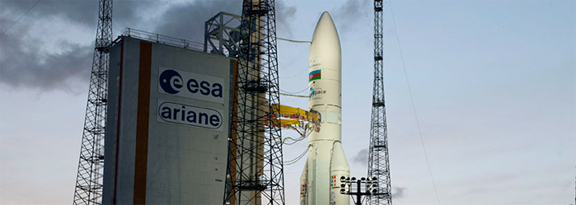
Poised for its on-time liftoff, Ariane 5 is photographed in the Spaceport’s ELA-3 launch zone – surrounded by tall towers that provide protect against
lightning strikes.
Photo courtesy of Arianespace.