

SES S.A. (Euronext Paris and Luxembourg Stock Exchange: SESG) announced its participation in the upcoming Artes-33 program "ELECTRA" of the European Space Agency (ESA). Under the ELECTRA program, SES and ESA will establish a public-private partnership aimed at developing a full-electric propulsion small/medium sized satellite platform manufactured in Europe.
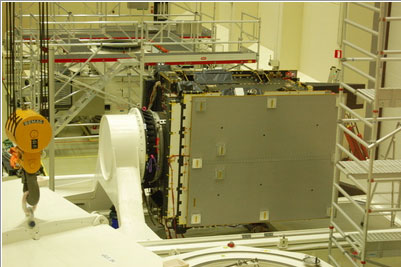
Small GEO prior to lifting it out of its container. Small GEO is a general-purpose small geostationary satellite platform that is giving European industry the opportunity to play a significant role in the commercial telecom market. Credits: ESA–R. Gruenagel
Specifically, the project aims to develop, implement, launch and commercially operate an innovative geostationary satellite platform that utilizes electric propulsion (instead of conventional chemical propulsion) for transfer into geostationary orbit as well as on orbit station keeping.
Thus, the satellite platform can take advantage of smaller launch vehicles or dual launch capabilities, while carrying payload capabilities equivalent to current mid-sized satellites in terms of power consumption and number of active transponders.
ELECTRA is one of the main ESA programs to which the Grand Duchy of Luxembourg has significantly subscribed at the recent ESA Ministerial Conference in Naples.
SES will lead the ELECTRA project and in particular the satellite design definition phase. To this end, SES will work in close cooperation with OHB System AG of Bremen, who will act as the prime contractor to SES.
"ELECTRA perfectly fits into the innovation priorities of SES. Decreasing the total cost of putting a payload into orbit is a key strategic element for the satellite operator community. Electric propulsion is poised to inject increased competitiveness into the satellite industry, an essential element for the sustained development of the satellite-based commercial telecommunications market. SES is pleased to trigger this ELECTRA initiative and to establish a strong relationship with ESA," said Martin Halliwell, SES Chief Technology Officer.
Through the Advanced Research in Telecommunications Systems (ARTES) program, ESA has been supporting the European satcom industry since 1975. The term ARTES may not be familiar to the end user of satcom; however, industry has called ARTES the key source in Europe for innovation in satellite communications.
ARTES offers different levels of financial aid allowing European industry to take bigger risks in developing new technologies. This secures Europe’s place in the worldwide satcom market.
But ARTES is more than a funding structure. It also includes the assistance of an experienced team of engineers offering guidance and invaluable advice, ensuring the best product possible will be created on time, and on budget.
This new section of telecom.esa.int will showcase the achievements the European satcom industry has experienced with the assistance of the ARTES program. From improvements to the devices used on the satellite itself, to ways signals can be improved and received on the ground, ARTES has played a large part in European satcom innovations.