

[SatNews] Once it reaches its final position it should revolutionize broadband communication in mobile telephony over the next 15 years.
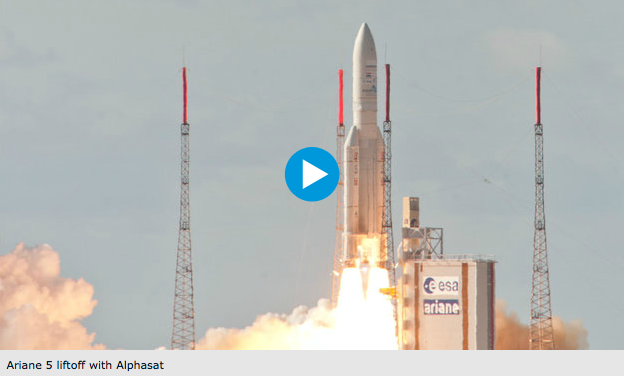
For the first time Berliner Glas optics is in outer space On 25 July 2013 Europe's largest and most sophisticated telecommunications satellite, Alphasat, was launched successfully into outer space on board an Ariane-5 rocket.
On August 6, 2013 Alphasat reached its preliminary position on a geostationary orbit at an altitude of approximately 36,000 kilometers. Once it reaches its final position it should revolutionize broadband communication in mobile telephony over the next 15 years.
Alphasat's main objective is the expansion of the global mobile network of the British mobile telephone service provider Inmarsat. Apart from Inmarsat's commercial payload, additional room is offered by the satellite to technologies that are supposed to be tested in geostationary orbit under the special conditions of outer space.

These four technological demonstration systems for the ESA also include a laser communications terminal (LCT) that Tesat-Spacecom has developed on behalf of Deutsches Zentrum für Luft- und Raumfahrt (DLR) (German Aerospace Center) with funds from Bundesministerium für Wirtschaft und Technologie (Federal Ministry of Economics and Technology) (code 50 YH 0632). The Berliner Glas Group supplied a very sophisticated optical component for this communications terminal.
Learn more about Berliner Glas at. The new data highway in outer space The LCT on board Alphasat ought to enhance communication in space. This system transmits data using light. This can transmit significantly larger volumes of data (at present approx. 1.8 gigabits per second corresponding to 130 DVDs per hour) in the same way that the introduction of fiber glass on the ground has speeded up communication. These terminals are also smaller and lighter than before and require less energy, constituting significant progress for operators of communication satellites.
For the first time the LCT on Alphasat is now testing transmission between low-orbit Earth observation satellites and a geostationary satellite at distances of up to 45,000 km. It was developed and built in preparation for the European Data Relay System EDRS. This can significantly improve Earth observation performance and will enable round-the-clock information exchange between satellites in the future.