

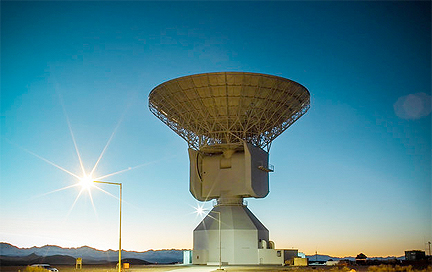
 [SatNews] A new satellite tracking station at Malargüe, Argentina, will be formally inaugurated on Tuesday, completing...
...the trio of deep-space stations and confirming ESA as one of the world’s most technologically advanced space organisations. The massive radio reflector dish of ESA’s new station is the most visible indication of the impressive technology that will soon track missions voyaging hundreds of millions of kilometres deep in our Solar System. Forty metres tall and with a moving antenna assembly weighing 610 tons, the station tracks missions at Mars and Venus and can also conduct radio science experiments, allowing scientists in Europe and Argentina to study the matter through which the spacecraft–ground communication signals travel. In exchange for hosting it for a planned 50 years, the station’s capacity will be shared with Argentina, whose CONAE national space office was an instrumental partner.
A 20kW amplifier enables transmission of telecommands hundreds of millions of kilometres into space, while low-noise amplifiers cooled to –258ºC enable receipt of ultra-weak signals from beyond Jupiter. To compare: The smartphone in your pocket transmits using a puny battery at about 125 milliwatts. This is millions of times more powerful than the signals that Malargüe can receive.