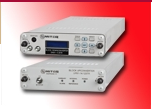
Available in all the satcom bands, the new addition to MITEQ´s patented (patent #7,510,090) family of 1/3 rack series of satcom products, provides block up and down converters with the additional feature of an internal amplitude slope adjustment of 4 dB nominal and as wide as 1 GHz bandwidth. The internal slope adjustment allows the user to balance the converter output to compensate for distribution & line losses subsequent to the converter.
The space savings 1/3 rack size permits in a standard 1 RU rack space the configuration of a redundant block converter system using two 1/3 rack converted and a 1/3 rack NSU switch over unit. Other redundant configurations or RF & IF satcom signal distribution systems can configures in a 1 RU space using other members of the MITEQ 1/3 rack product family;
- C-, X-, Ku-, DBS-, K-, & Ka- BUC-s & DNC-s
- Test translators for all bands
- Fiber optic transmitters & receivers
- IF amplifiers with or without slope equalization
- Satcom bands and IF band frequency synthesizers
- Redundant switch over units
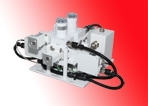
MITEQ introduces a low noise series of redundant Ka-band Low Noise Block Converter (LNB) assemblies covering from 17.7 to 21.2 GHz in 5 specific bands of either a 500 MHz or a 1 GHz bandwidth. The noise temperature of the LNBs is typically 100 K at 21.2 GHz and 110 K maximum. LNB gains of 40 dB, 50 dB, and 60 dB are available with the 60 dB model as a catalog model. The phase noise of the LNBs are superior to the phase noise specification of MIL-STD-188-164B.
The plate assemblies are fully redundant; outdoor antenna mounted products, and come in the following configurations; 1:1, 1:2, & Dual 1:1. Each version is supplied with its corresponding indoor rack mount 1RU controller. Remote control via RS485 / RS 422 or optional 10/100 Base-T Ethernet is provided. Both the LNBs & power supplies are hot swappable.
In addition to the Ka-band redundant LNB assembly MITEQ also supplies similar versions in C, X, & Ku-bands as well as redundant LNA Plate assemblies in all the satcom bands. Other redundant, outdoor antenna mount assemblies available from MITEQ are line driver amplifiers, and WS series high performance block up & down converters
The UPC2 can precisely adjust up to 10 independent Tx IF channels with up to 20 dB of attenuation in 0.2dB steps.
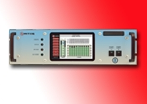
The UPC2 is a rack mount, 2RU, unit which is place in series & prior to the BUC with from 1 to 10 independent BUC´s Tx channels being controlled by one UPC2. The specific path attenuator setting is determined by the UPC2 monitoring the satellite´s beacon provided from a separately supplied beacon receiver (see MITEQ´s BR-L beacon receiver). The UPC2 then accurately determines the IF path attenuator value from the minimum insertion loss value up to a -20 dB Tx power correction level in 0.2 dB steps. The UPC2 can also directly control MITEQ WS series BUCs without using the UPC2 attenuators, thereby, eliminating the need to add attenuator options to control multiple MITEQ BUCs.
The UPC2´s Site Diversity Switching Option permits communication between a local site UPC2 & a redundant remote site UPC2 which controls that sites Tx link. For example, if a deep Ka-band rain fade of 12 dB occurs at the local site while the remote site is unaffected, the two UPC2s communicate via an Ethernet link, and based on the user programed down link signal strength measurement redirects the redundant IF signals to the clear air, remote site so that the overall power level seen at the satellite transponders is maintained & balanced.
The UPC2 has an attractive, color touch screen display for easy user interface. Remote control is available through an Ethernet interface supporting HTTP, or Telnet, or SNMPv1. Each UPC2 is equipped with fully redundant power supplies.
Topical Tags :
Regional Tags :