

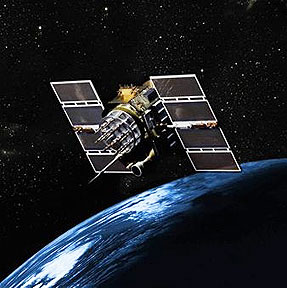
GPS Block IIA satellite, artistic rendition, courtesy of U.S.A.F.
GPS Block IIA-11 (SVN-24), built by Boeing (formerly Rockwell Corporation), was launched on July 4, 1991, and set healthy to navigation and timing users on Aug. 31, 1991. SVN-24 will reach 20 years on-orbit on July 4. SVN-24 was the second space vehicle in the series of the GPS IIA satellites to be launched with a design life of 7-½ years. Not only are the GPS Block IIA satellites exceeding their design life, they are actually doubling it. In the case of SVN-24, along with SVN-23, launched on Nov. 26, 1990, their on-orbit life has nearly tripled.
The GPS Block IIA satellites were launched in the early 1990s to complete the GPS constellation, allowing Air Force Space Command to declare Full Operational Capability on April 27, 1995. The current GPS constellation consists of 31-operational satellites on-orbit; 11 GPS Block IIA, 12 IIR, 7 IIR-M and the first GPS IIF satellite. The second GPS IIF satellite is on-track to launch from Cape Canaveral AFS, Fla., July 14.
The GPS Directorate of the Space and Missile Systems Center is committed to making sure that GPS will be there when the world needs it. In order to ensure GPS continues to deliver sustained, reliable GPS capabilities to the warfighter, U.S. allies and civil users. The GPS Directorate has ongoing modernization upgrades in work to the space, control and user equipment. These upgrades will provide improved anti-jam capabilities for the warfighter and improved security for all users. For instance, the new capabilities of the IIF satellites will provide greater navigational accuracy through improvements in atomic clock technology, a more robust signal for commercial aviation and safety-of-life applications, known as the new third civil signal (L5), an on-board reprogrammable processor and a 12-year design life providing long-term service and reduced operating costs.
GPS has played a critical role in establishing the importance of our space superiority and has changed the way we fight war. GPS has become both a part of our culture and a key component of our National Infrastructure. Users can rely on GPS with confidence today and into the future. The GPS constellation is the most robust and capable system in the history of space. The navigation and timing signals provided by GPS satellites have changed tactics, enabling precision operations and more importantly saving lives by helping minimize collateral damage.