

 [SatNews] Northrop Grumman Corporation (NYSE:NOC), the Colorado State University (CSU) College of Engineering and Cherry Creek Schools, teamed up this summer to get kids excited about careers in science, technology, engineering, mathematics (STEM) and cybersecurity during the first STEM/Cybersecurity Summer Camp.
The camp was held from July 29th. through August 2nd. at Grandview High School, and offered students an opportunity to learn about and apply the technologies that are fueling tomorrow's workforce. Forty-five students from the Denver metro area in grades 9-12 participated in this two-track camp where students learned from experts in the field about clean energy technologies and cybersecurity. The camp was offered at no charge to students, thus expanding its reach to students to position them for success.
"Our nation is facing a critical shortage of students interested in the STEM disciplines," said Marcos Stephens, manager, engineering training programs, Northrop Grumman Information Systems in Aurora. "We want to encourage students to get interested in STEM and cybersecurity to build a diverse employee pipeline of professionals who are poised to take on tomorrow's national challenges. We worked with some of the brightest kids in the Denver metro area and were privileged to be a part of an amazing team that made this possible."
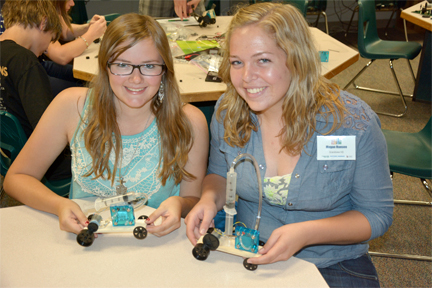
Students show-off their clean-energy hydrogen fuel cell-powered cars built during the Northrop Grumman/Colorado State University/Cherry Creek Schools STEM/Cybersecurity Summer Camp.
Students from CSU College of Engineering taught the clean energy track covering clean energy systems, the causes and effects of climate change, relationships between electricity and magnetic fields, wind power, solar power, hydrogen fuel cells, and energy conservation. At camp, students built a wind-powered generator and solar-powered charging station to learn how clean energy derived from these two hybrid systems could energize a hydrogen fuel cell-powered car. The week culminated with hydrogen fuel-cell car races and energy conversion challenges associated with clean energy drive systems.
"Today's students must see the utility and value of learning STEM subjects," said Michael de Miranda, professor of engineering education at Colorado State. "Solving real engineering design problems like the hybrid power generation systems integrated into a hydrogen fuel-cell charging station gives them a first-hand opportunity to 'connect the STEM dots' and experience the excitement and challenge of doing engineering."