

The satellite’s X-ray and gamma ray detection modules, developed and produced by Sagem’s Safran Electronics division in Valence, each comprise 32 cadmium telluride (CdTe) detectors and an application-specific integrated circuit (ASIC), based on high-temperature co-fired ceramic (HTCC) elements. The Eclairs telescope will group 200 of these subassemblies to form a detector with total sensing area of 1,000 square centimeters.
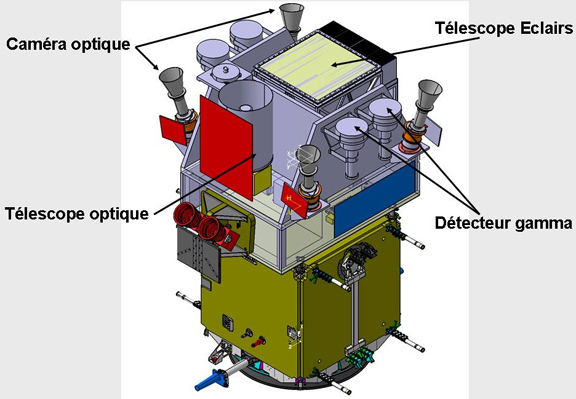
Diagram of the SVOM scientific satellite
The SVOM mission is primarily designed to study gamma-ray bursts, the most violent events in the Universe – not counting the Big Bang of course. The celestial bodies created by gamma-ray bursts (the huge explosion of a massive star at the end of its life) offers huge potential for cosmological studies, in particular the possible detection of the first stars in the Universe, and a survey of the cosmos. The Eclairs telescope is the primary mission instrument, and is being built under the auspices of French space agency CNES, in conjunction with the CESR lab and the French atomic energy commission CEA. The SVOM spacecraft will be launched in 2015 as part of a joint French-Chinese mission organized by the Chinese space agency, the Chinese Academy of Sciences and CNES.