

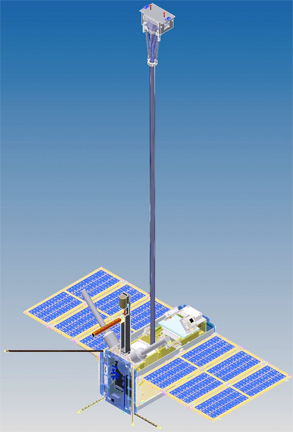
Artistic rendition of the Chibis-M microsatellite, courtesy of ScanEX RDC
...studying lightning discharges in the Earth atmosphere and the resulting gamma-radiation, was placed into its working orbit. This microsatellite was created at the RAS Institute of Space Research with different scientific and research and development organizations. Specialists of ScanEx RDC and nowadays of its affiliated company, Sputnix, have developed a system for the orientation and stabilization (SOS) of this spacecraft. Within the year of successful satellite operation the methods of control, routine operations and troubleshooting instructions have been tested and fine tuned. Megabytes of telemetry and gigabytes of scientific data have been received.
In particular, the orientation and stabilization system of the satellite has been operating nominally. In December 2012, another attitude sensors calibration was done, which enabled the company to stablize the satellite with a greater accuracy. Operations to upgrade the onboard software for streamlining the attitude control system procedures and for testing the upgraded algorithms are planned for February.
A conference, organized by the RAS Institute of Space Research, will take place in mid-February in Tarusa (Kaluga Region). Participants of the event will discuss the results of the first year of the satellite operation. Sputnix company specialists plan to present the results of the SOS system during the conference and to offer its upgraded version with due account for the operation experience for further implementation of micro-satellite projects.