

• Skip to primary navigation
  • Skip to main content
  • Skip to primary sidebar
  • Skip to secondary sidebar
  • Skip to footer
  • NEWS:
  • SatNews
  • SatMagazine
  • MilSatMagazine
  • SmallSat News
  • |     EVENTS:
  • SmallSat Symposium
  • Satellite Innovation
  • MilSat Symposium
  • SmallSat Europe

SatNews

Satellite Industry Intelligence Since 1983

Subscribe
  • LATEST
  • SatNews Events
  • Magazines
  • Calendar
  • Subscribe
  • Missions & Constellations
    • Exploration & Science Missions
    • In-Orbit Servicing & Orbital Operations
    • LEO Constellations
    • Mission Autonomy & Onboard Systems
    • Mission Deployments & Manifests
    • Navigation & PNT
    • SmallSat
    • Spacecraft & Payload Technology
    View All in Missions & Constellations →
    The Silent Overhaul: How Software-Defined Routing and Cloud Ingestion Flattened the Aerospace Hardware StackThe Silent Overhaul: How Software-Defined Routing and Cloud Ingestion Flattened the Aerospace Hardware Stack
    Hybrid Earth Intelligence: NASA Expands Commercial Satellite Data Integration in $476M Cloud-Driven PushHybrid Earth Intelligence: NASA Expands Commercial Satellite Data Integration in $476M Cloud-Driven Push
    Hybrid Edge Mobility: Contrivian Launches “Horizon Plus” to Deliver Intelligent Multi-Orbit Field CommunicationsHybrid Edge Mobility: Contrivian Launches “Horizon Plus” to Deliver Intelligent Multi-Orbit Field Communications
    Space Tech vs. Biothreat: GMV Deploys Earth Observation and AI Core to Fight Invasive Pacific Seaweed in PortugalSpace Tech vs. Biothreat: GMV Deploys Earth Observation and AI Core to Fight Invasive Pacific Seaweed in Portugal
  • Business
    • Contracts & Commercial Deals
    • Earnings & Financial Reporting
    • Events & Conferences
    • Funding & Venture Capital
    • Market Forecasts
    • Mergers & Acquisitions
    • Personnel Moves & Appointments
    View All in Business & Finance →
    The Spatial Photonics Crunch: Inside the Invisible Supply Chain Threatening Orbital Laser NetworksThe Spatial Photonics Crunch: Inside the Invisible Supply Chain Threatening Orbital Laser Networks
    Sovereign Space Expansion: Spain’s FOSSA Systems Secures €9.25M to Scale Defense Constellation and SIGINT InfrastructureSovereign Space Expansion: Spain’s FOSSA Systems Secures €9.25M to Scale Defense Constellation and SIGINT Infrastructure
    Next-Gen Spatial Intelligence: BAE Systems Secures Agreement to Build High-Resolution Vantage Satellite Buses for VantorNext-Gen Spatial Intelligence: BAE Systems Secures Agreement to Build High-Resolution Vantage Satellite Buses for Vantor
    New Lobbying Force: Top NGSO Operators Unveil “SpaceConnect Association” in WashingtonNew Lobbying Force: Top NGSO Operators Unveil “SpaceConnect Association” in Washington
  • Defense
    • Counterspace & ASAT
    • Defense Budgets & Procurement
    • ISR & Reconnaissance
    • MILSATCOM
    • Missile Warning & Defense
    • National Security Programs
    • Space Domain Awareness
    View All in Military & Defense →
    Digital Twins for Space Command: Sedaro Tapped by Space Force to Build Federated Engineering PlatformDigital Twins for Space Command: Sedaro Tapped by Space Force to Build Federated Engineering Platform
    The Strategic Redistribution of Iranian Aerospace CapabilityThe Strategic Redistribution of Iranian Aerospace Capability
    Navigating Contested Battlespaces: Military GPS Receiver Market Approaches $3 Billion Amid Electronic Warfare SurgeNavigating Contested Battlespaces: Military GPS Receiver Market Approaches $3 Billion Amid Electronic Warfare Surge
    Preparing for Day One: DARPA Solicits Tech to Rebuild Destroyed Satellite Fleets Within HoursPreparing for Day One: DARPA Solicits Tech to Rebuild Destroyed Satellite Fleets Within Hours
  • Gov
    • Export Controls & Compliance
    • International Space Agreements
    • National Space Policy
    • Space Law & Treaties
    • Space Sustainability & Debris Policy
    • Space Traffic Management / Debris Removal
    View All in Government & Regulation →
    $3.57 Billion Milestone: FCC Advanced Wireless Services (AWS-3) Spectrum Auction Concludes$3.57 Billion Milestone: FCC Advanced Wireless Services (AWS-3) Spectrum Auction Concludes
    Who Has Authority to Intervene in a Space-Based Emergency?Who Has Authority to Intervene in a Space-Based Emergency?
    Staying in Their Lanes: SpaceX and Globalstar Join Forces to Defend Spectrum ExclusivityStaying in Their Lanes: SpaceX and Globalstar Join Forces to Defend Spectrum Exclusivity
    Orbital Paperwork War: China’s Spectrum Squatting Reserves 244,000 Satellite Slots to Combat SpaceX’s LEO MonopolyOrbital Paperwork War: China’s Spectrum Squatting Reserves 244,000 Satellite Slots to Combat SpaceX’s LEO Monopoly
  • Launch
    • Launch Providers
    • Launch Schedule & Calendars
    • Launch Sites & Infrastructure
    • Rocket Technology & Vehicles
    View All in Launch →
    Arianespace fights back – possibly!Arianespace fights back – possibly!
    Direct-to-Device Momentum: AST SpaceMobile Successfully Launches Giant Next-Gen BlueBird Satellites Atop SpaceX Falcon 9Direct-to-Device Momentum: AST SpaceMobile Successfully Launches Giant Next-Gen BlueBird Satellites Atop SpaceX Falcon 9
    SpaceX’s Secret ‘Starfall’ Capsule Wins FAA Approval for Pacific Reentry TestsSpaceX’s Secret ‘Starfall’ Capsule Wins FAA Approval for Pacific Reentry Tests
    Breaking the TRL Bottleneck: Space Phoenix Systems Debuts Cost-Effective Space Test-and-Return ServiceBreaking the TRL Bottleneck: Space Phoenix Systems Debuts Cost-Effective Space Test-and-Return Service
  • Software
    • Autonomous Ground Operations
    • Data Processing & AI/ML
    • Digital Twins & Modeling
    • Ground Segment & Teleports
    • Mission Planning & Simulation
    • Space Systems Software Engineering
    • Spectrum & Licensing
    View All in Software Automation & Ground Systems →
    Powering the Automated Floor: Intralogistics Operators Must Unify AGV Charging InfrastructurePowering the Automated Floor: Intralogistics Operators Must Unify AGV Charging Infrastructure
    Poland Sovereignty: GMV to Develop Core Ground Control Platform for CAMILA ConstellationPoland Sovereignty: GMV to Develop Core Ground Control Platform for CAMILA Constellation
    Software Over the Air: FatPipe Launches Acceleration Tool to Unclog Starlink and Amazon LEO LinksSoftware Over the Air: FatPipe Launches Acceleration Tool to Unclog Starlink and Amazon LEO Links
    Three LEO Operators Bet 2026 on a Supply Chain Built for 2027Three LEO Operators Bet 2026 on a Supply Chain Built for 2027
  • Services & Apps
    • Climate & Environmental Monitoring
    • Disaster Response & Security Mapping
    • Earth Observation & Imaging
    • Maritime & Aviation Satcom
    • Satellite Communications
    View All in Services & Applications →
    National SAR Defense: Norway Selects ICEYE for Nationwide Space-Based Flood and Hazard Monitoring SystemNational SAR Defense: Norway Selects ICEYE for Nationwide Space-Based Flood and Hazard Monitoring System
    Sovereign Milestone: OQ Technology Achieves Europe’s First Drone Video Transmission via 3GPP NTN LEO SatelliteSovereign Milestone: OQ Technology Achieves Europe’s First Drone Video Transmission via 3GPP NTN LEO Satellite
    Ghost Viewers trigger secondary ripple effect on Satellite Communications (SatCom)Ghost Viewers trigger secondary ripple effect on Satellite Communications (SatCom)
    Fleet-Wide Hybrid Networks: Marlink Integrates Starlink Across 80+ Oldendorff Carriers VesselsFleet-Wide Hybrid Networks: Marlink Integrates Starlink Across 80+ Oldendorff Carriers Vessels

The End of the Open Range: LEO’s Spectrum Crunch Hits Home

February 11, 2026

By Abbey White, Staff Writer, SatNews

Dispatch from SmallSat Symposium. Coverage and analysis from across the conference, tracking the forces shaping the next phase of the SmallSat market.
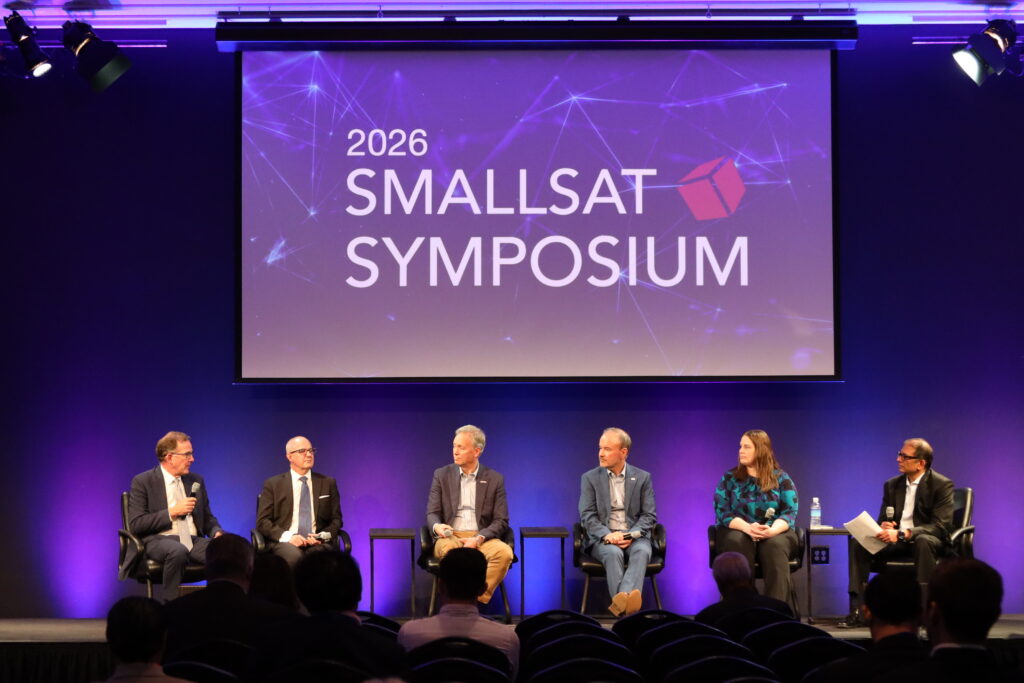
With over 14,000 satellites in orbit and filings for hundreds of thousands more flooding the International Telecommunication Union [ITU], the industry has hit a wall. Success is no longer determined by who can launch the fastest. Instead, it depends on who can find a clear frequency to talk back to Earth without being drowned out by the noise.

During the Satellite Spectrum and Regulation Discussion at SmallSat Symposium, a panel that could have provided a dry recitation of legal codes played out like a crisis briefing. Ahsun Murad, CEO of Optimal Satcom, wasted no time laying out the staggering mathematics of the current orbital environment. He pointed to massive filings coming out of China, specifically the CTC-1 and CTC-2 constellations.

Murad noted, “In total their filings exceed 200,000 satellites now.”

That number silenced the room. It breaks the traditional models of orbital management. The spectrum, once a vast and forgiving resource, has become a contested industrial corridor. The panel delivered a clear warning to those building business cases on the assumption of easily securing Ku or Ka-band rights: You are already too late.

The Regulatory Assembly Line

The U.S. government is frantically attempting to modernize its approach before the sky becomes unmanageable. The FCC’s recent Space Month initiative and the proposed Part 100 rules represent the most significant overhaul of satellite licensing in fifty years. The goal is to dismantle the static, paper-heavy Part 25 regime, designed for an era when satellites were billion-dollar monoliths that stayed in one spot for fifteen years, in favor of a system built for speed.

Karl Kensinger, Special Counsel at the FCC’s Space Bureau, described a system under immense pressure. The agency is trying to move from a bespoke, artisan review process to what the research brief describes as a licensing assembly line.

Kensinger admitted that the current regulatory systems “probably aren’t at the right pace—in fact, definitely are not at the right pace.”

Kensinger’s admission highlights a perilous gap between technology and policy. While SpaceX performs 300,000 collision avoidance maneuvers a year, regulators are still working to implement conditional grants that would allow operators to build at risk while waiting for final checks. The new Part 100 framework aims to disaggregate the review process, allowing safety and spectrum reviews to happen on parallel tracks. Yet this transition creates a fresh purgatory for companies already stuck in the queue.

The Noise Floor is Rising

Tension rose when the conversation turned to interference. For decades, the industry has operated on the gentleman’s agreement that Geostationary (GEO) satellites are the primary residents of the spectrum, protected by strict Equivalent Power Flux Density (EPFD) limits. But with thousands of LEO satellites now screaming across the sky, that protection is fraying.

Bill Milroy, CTO of ThinKom, cut through the diplomatic talk regarding the conflict between incumbent operators and new entrants. While technical teams on both sides argue over whether the new constellations will degrade service for legacy users, Milroy was blunt about the physical reality.

“The noise floor is going to go up,” Milroy stated. “If you’re a big dish that’s trying to operate QAM 1024 and you need 35 dB of signal to noise ratio, you do care about the noise level.”

This represents the industry’s inconvenient truth. You cannot add 100,000 transmitters to the sky without degrading the signal environment for everyone. The spectrum is a finite resource. We are reaching the limits of what traditional Ku and Ka bands can carry.

Escaping the Crunch

Confronted by this saturation, the industry is trying to engineer its way out of the trap. The panel highlighted two primary escape routes: going higher in frequency, or switching to light.

Jennifer Salmon, Chief Product Officer at Elve, argued that the only way forward is to exploit the massive, unused bandwidth in the V, W, and E bands. Her company uses nanotechnology to mass-produce Traveling Wave Tube Amplifiers (TWTAs) that can generate enough power to punch through the atmospheric attenuation plaguing these high frequencies.

Salmon explained the shift simply: “We’re all trying to do the same thing, provide more spectrum as things get tighter and tighter up there.”

On the other side of the divide is the optical camp. Jeff Huggins of Cailabs made the case that the RF spectrum is a legacy bottleneck. His firm is deploying optical ground stations that use lasers to downlink data, bypassing the ITU’s radio regulations entirely. The mesh net in the sky created by Starlink and the Space Development Agency is creating a new backbone where data hops from satellite to satellite via laser, only touching the ground where necessary.

Huggins noted, “It’s going to be necessary, just because the amount of data that’s up there.”

The Geopolitical Stakes

Underlying every technical debate in Mountain View this week is the silent pressure of geopolitical competition. The urgency behind the FCC’s reforms and the NTIA’s modernization efforts is not just about commercial efficiency. It is about occupying the high ground before competitors do. The first-mover advantage in LEO is not just about market share; it is about establishing de facto standards for orbital behavior and spectrum usage.

As Ahsun Murad’s opening statistics reminded the audience, the U.S. is not the only player with mega-constellation ambitions. If the FCC cannot streamline its assembly line to license American systems faster, state-backed entities that do not wait for public comment periods will consume the orbital shells and frequency filings.

The consensus leaving the session was grim but determined. The era of permissionless innovation where startups could launch first and ask forgiveness later is ending. It is being replaced by a regime of managed congestion, where survival depends as much on your regulatory strategy as your link budget. The sky is still open, but the price of admission just went up.

Filed Under: Government & Regulation, Spectrum & Licensing Tagged With: SmallSat Symposium 2026

Primary Sidebar

Coverage

  • Missions & Constellations
  • Business & Finance
  • Military & Defense
  • Launch
  • Software Automation & Ground Systems
  • Government & Regulation
  • Services & Applications

Most Read Stories

  • SpaceX’s Secret ‘Starfall’ Capsule Wins FAA Approval for Pacific Reentry Tests
  • American military space closed around one company in seven days
  • Analyst Projects Massive Subscription Growth for Starlink Ahead of Imminent SpaceX IPO
  • Major opportunities for 2 GHz over Europe
  • Amazon Leo Constellation Surpasses 330 Satellites Following Latest Atlas V Launch

Secondary Sidebar

Footer


Satnews is a leading provider of satellite news, events, publications, research and other satellite industry information in both commercial and military enterprises worldwide.

Stories By Category

  • Business & Finance
  • Government & Regulation
  • Launch
  • Military & Defense
  • Missions & Constellations
  • Services & Applications
  • Software Automation & Ground Systems
  • Spectrum & Licensing
  • Startups & NewSpace Business

About Us

  • Leadership & Editorial Team
  • SatNews History
  • Free Satnews Subscription
  • SatNews Events
  • Magazines

Navigation

  • Latest Stories
  • Magazines
  • Events
  • Contact
  • Cookie & Privacy Policy for Satnews

We use cookies to ensure that we give you the best experience on our website. If you continue to use this site we will assume that you are happy with it.
x
Sign up Now (For Free)
Access daily or weekly satellite news updates covering all aspects of the commercial and military satellite industry.
Invalid email address
Notify Me Regarding ( At least one ):
We value your privacy and will not sell or share your email or other information with any other company. You may also unsubscribe at anytime.

Click Here to see our full privacy policy.
Thanks for subscribing!